

Soudah Peaks: Saudi Arabia’s New Mountain Tourism Giga-Project, Explained


Introduction
Every other major Saudi giga-project so far has been about coastline, desert, or heritage. Soudah Peaks is the outlier, a year-round luxury mountain destination being built 3,015 metres up the Kingdom’s highest peak, in a climate and terrain that genuinely doesn’t resemble anywhere else in Saudi Arabia’s development pipeline. That difference isn’t just scenic, it changes what the project actually needs from its supply chain, starting with water.
This piece explains what Soudah Peaks actually is, where it stands today, and why its water and utility infrastructure, more than almost any other part of the build, makes it a distinctive opportunity for suppliers, particularly in pumps and water systems.
What Is Soudah Peaks?
Soudah Peaks is a Public Investment Fund giga-project developed by Soudah Development Company (SDC), chaired by Crown Prince Mohammed bin Salman, positioned as Saudi Arabia’s first year-round mountain tourism destination. It sits in the Aseer region, at 3,015 metres above sea level on the Kingdom’s highest peak, spanning a master plan of roughly 635 square kilometres across Soudah and parts of Rijal Almaa.
At full build-out, the project is planned to deliver around 2,700 hospitality keys, 1,336 residential units, roughly 3,000 staff accommodation units, and 80,000 square metres of commercial space, with a target of two million annual visitors once complete.
The Six Development Zones
Why it matters: Soudah Peaks isn’t a single site, it’s structured across six distinct development zones, each with its own scale and character, which matters for suppliers trying to understand where and when specific material demand will actually land.
- Tahlal, the largest zone by area at roughly 766,000 square metres.
- Sabrah, spanning approximately 155,600 square metres.
- Sahab, covering roughly 57,200 square metres.
- Red Rock, at approximately 40,400 square metres.
- Rijal, the smallest confirmed zone at roughly 14,700 square metres.
- Jareen, the final zone in the development sequence, with total area still to be confirmed.
Where Things Stand Today
Why it matters: Understanding how mature this project actually is matters for suppliers deciding when and how to position themselves.
Soudah Peaks is earlier in its development curve than projects like the Red Sea Project, AMAALA, or Diriyah Gate. AECOM was appointed as lead design consultant for the project’s first phase, and Parsons Corporation was appointed as project management consultant overseeing site supervision across all six zones. As of early 2026, total construction contracts awarded to Soudah Peaks remained under $100 million, reflecting a project still moving from planning into early delivery, with the bulk of its major packages yet to be tendered.
The most significant package awarded to date is a SAR 1.3 billion power infrastructure agreement with National Grid SA, a Saudi Electricity Company subsidiary, signed in January 2026, covering one 380kV/132kV bulk supply point, two primary substations, and 142 distribution substations across the site.
The Water Infrastructure Behind the Mountain
Why it matters: This is where Soudah Peaks becomes genuinely distinctive, and where the project’s supply chain opportunity is most concrete for water and pump equipment specifically. Publicly disclosed infrastructure requirements for the site include:
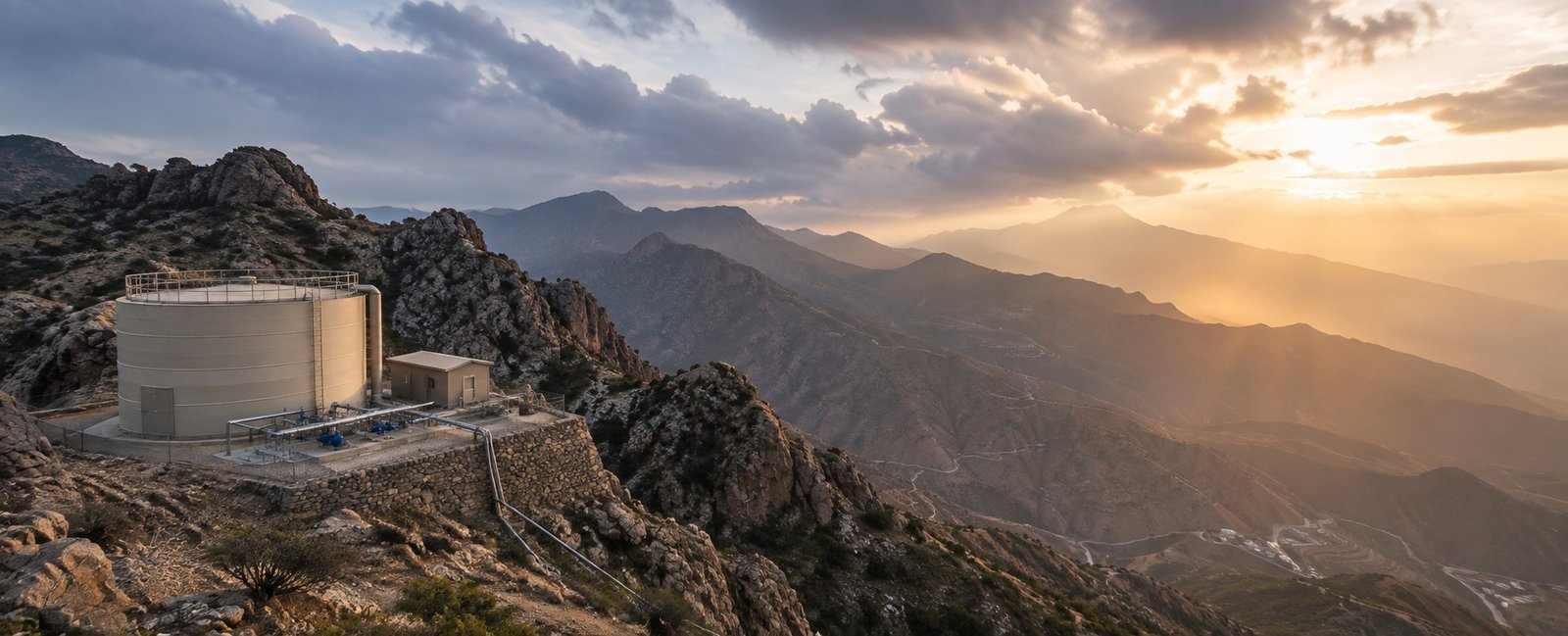
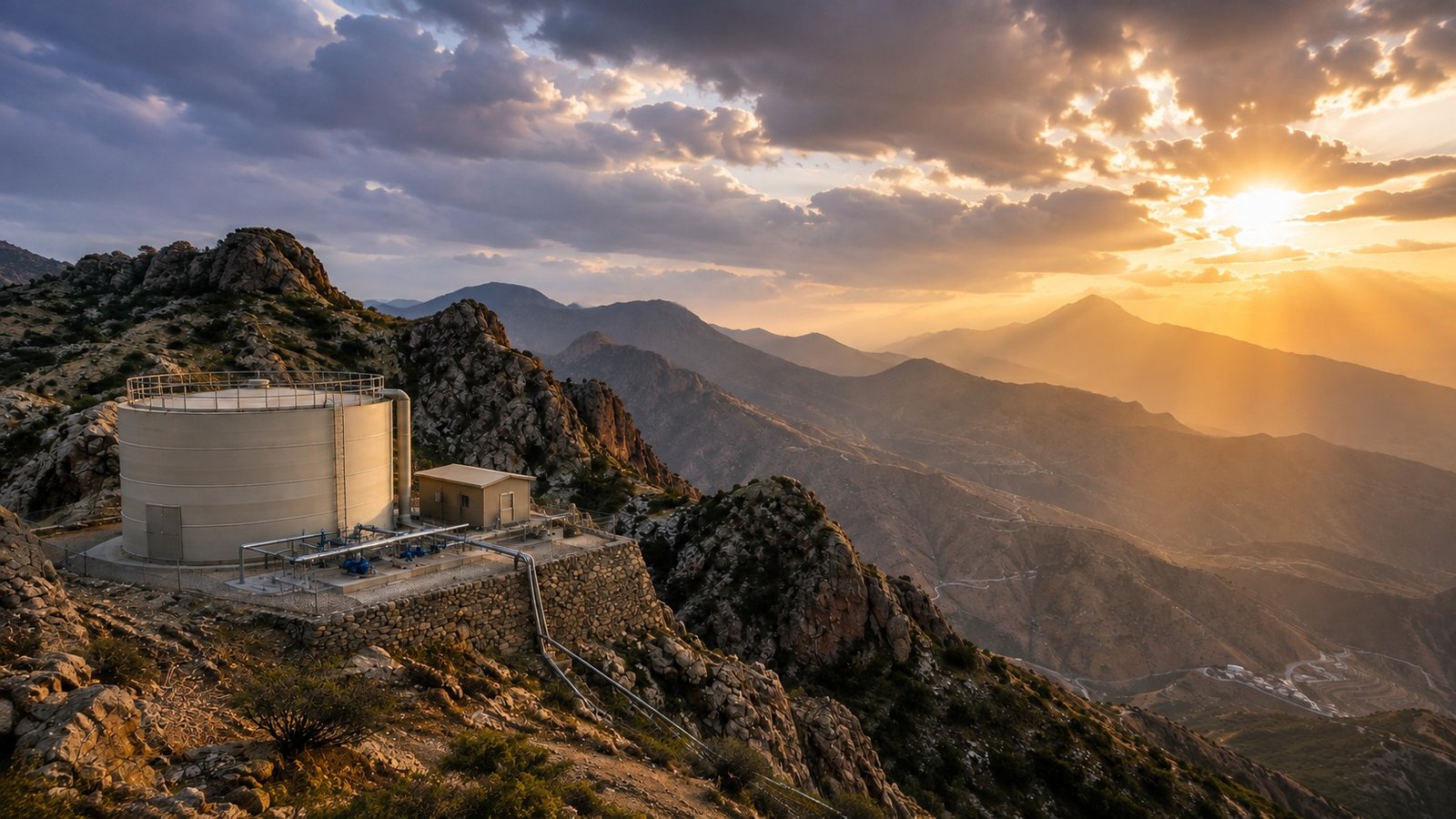
- 15 water storage tanks and pump stations, with a combined storage capacity of roughly 93,150 cubic metres, built to serve an expected demand of approximately 10,984 cubic metres per day.
- 14 sewage treatment plants, with a total treatment capacity of around 10,690 cubic metres per day.
- 52 sewage lifting stations, required to move wastewater across the site’s mountainous terrain.
Why this matters for pumps specifically: Moving and storing water across a development spread over a mountain peak is a fundamentally different engineering problem than a flat coastal or urban site. Water has to be pumped uphill against gravity to reach elevated zones, sewage has to be lifted across dramatic elevation changes between zones, and storage infrastructure has to be distributed across the site rather than centralized. That’s exactly why the project’s own infrastructure disclosures list water storage tanks and pump stations, and dozens of sewage lifting stations, as core components, not secondary details.
Why High Altitude Changes the Building Materials Equation
Why it matters: At over 3,000 metres, Soudah Peaks experiences a noticeably cooler climate than the rest of Saudi Arabia, including occasional near-freezing temperatures in winter months, a genuine departure from the heat-dominant conditions that shape material choices almost everywhere else in the Kingdom’s construction sector.
This shifts supplier priorities in ways that don’t apply to a coastal or desert-lowland project:
- Cold and freeze-tolerance considerations become genuinely relevant for exposed plumbing and outdoor fittings, unlike almost anywhere else in Saudi Arabia’s giga-project pipeline.
- Elevation affects pump performance. Pumps and water systems designed for standard atmospheric and pressure conditions need to account for the effects of altitude on flow and pressure characteristics.
- Rugged terrain complicates logistics. Delivering bulk materials to a mountain site spread across six zones requires more careful planning than a flat urban or coastal delivery route.
- Heritage and nature preservation is a stated project priority, according to Soudah Peaks’ own leadership, which likely shapes material and construction approach choices around minimizing environmental disruption to the surrounding mountain ecosystem.
What This Project Actually Needs From Suppliers
Why it matters: Between the disclosed infrastructure package and the hospitality-led masterplan, Soudah Peaks’ supplier needs span two distinct categories.
- Water and pump infrastructure at scale, covering storage tank systems, pump stations built to handle elevation-driven pressure demands, and sewage lifting stations distributed across a mountainous, multi-zone site.
- Luxury hospitality-grade plumbing and fittings, given the project’s ultra-luxury positioning and likely partnership with major international hospitality operators across its 2,700 planned hospitality keys.
- Residential and staff accommodation-grade building materials, covering the 1,336 residential units and roughly 3,000 staff accommodation units planned across the site.
- Cold-tolerant and altitude-appropriate materials, a genuinely unique requirement compared to every other current Saudi giga-project.
Why an Early-Stage Project Is a Different Opportunity
Why it matters: As covered in our pieces on the Red Sea Project and AMAALA, Diriyah Gate, and SPARK, those projects already have tens of billions of dollars in contracts awarded, meaning much of their tier-one contractor landscape is already established. Soudah Peaks, with under $100 million awarded to date, is at an earlier stage, most of its major infrastructure and construction packages haven’t been tendered yet.
Practical tip: For suppliers, an early-stage giga-project like this represents a different kind of opportunity than a mature one. There’s more room to build relationships with design consultants like AECOM and project managers like Parsons before the main contractor landscape solidifies, rather than trying to break into an already-established supply chain years into delivery.
What Makes a Supplier “Giga-Project Ready”
The same core factors apply here as across Saudi Arabia’s other giga-projects: in-house manufacturing rather than reselling, certified quality standards, a genuinely broad and relevant product range, and a track record with established contractors. For Soudah Peaks specifically, water and pump system expertise, and a genuine understanding of altitude-driven engineering considerations, add real differentiation beyond the baseline criteria.
Practical Takeaways for Suppliers
- Position early, before major packages are tendered. With most of Soudah Peaks’ construction contracts still ahead, this is an earlier entry point than most other current giga-projects.
- Lead with water and pump infrastructure expertise specifically. The project’s own disclosed requirements, storage tanks, pump stations, and sewage lifting stations, make this the most concrete and quantified opportunity area.
- Understand the altitude factor before pitching. Suppliers who can speak specifically to elevation-driven pump performance and cold-tolerant materials stand out from those offering standard lowland Saudi specifications.
- Watch for AECOM and Parsons-linked tenders, since design and project management consultants often shape early package specifications before main contractors are even selected.
- Track zone-by-zone development, since Soudah Peaks’ six zones vary significantly in scale, and material demand will likely roll out zone by zone rather than all at once.
Conclusion
Soudah Peaks stands apart from Saudi Arabia’s other giga-projects for a simple reason, it’s the only one built on a mountain. That single fact reshapes its supply chain needs in ways that are directly relevant to water and pump infrastructure specifically, and it’s still early enough in its development timeline that suppliers positioning now have a genuine head start before the bulk of its construction packages reach the market.
Your next steps:
- Review Kanzotech Pumps’ capability against Soudah Peaks’ disclosed water storage, pump station, and sewage lifting requirements.
- Track AECOM and Parsons-linked tender activity as design packages move toward construction.
- Explore Kanzotech’s water pumps, industrial pump range, and building accessories to see how an in-house manufactured, ISO certified product line fits into an early-stage, high-altitude giga-project.
Looking to explore a supply opportunity tied to Soudah Peaks or another giga-project? Contact Kanzotech to discuss your project’s requirements.










Comments
No comments yet. Be the first to comment!