Import vs Local Manufacturing: What Saudi Buyers Should Understand About Building Material Sourcing

POSTED BY: Hyzam Kanzo / August 6, 2026
Views
110 Views
0 Comments

Introduction

For years, the decision between importing building materials and sourcing them locally in Saudi Arabia came down mostly to price and availability. That’s no longer the whole picture. A regulatory shift is underway that touches the exact product categories a plumbing, pumps, and building accessories buyer deals with every day, and it changes what “cheaper” actually means once compliance, certification, and procurement eligibility are factored in.

This piece walks through what’s actually different now, where imported materials still make sense, and what a contractor, trader, or procurement manager should weigh before defaulting to either option.

What’s Actually Changed


Why it matters: The old assumption, that importing is simpler and local manufacturing is a compliance nicety, doesn’t hold up as well as it used to. Two separate regulatory tracks now shape sourcing decisions directly.

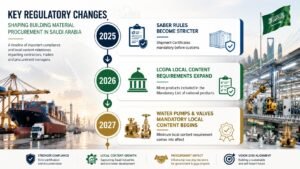
  • SASO and SABER certification is mandatory for imports, not optional. Every regulated product entering Saudi Arabia needs a Product Certificate of Conformity and a Shipment Certificate of Conformity issued through the SABER platform before it can clear customs, and since January 2025, certificates obtained after a shipment arrives are treated as non-compliance rather than a fixable delay, risking re-export at the importer’s expense.
  • Plumbing products carry an added certification layer. Faucets, shower systems, and tanks require a Water Efficiency Label on top of the standard Certificate of Conformity, which means an imported faucet line needs to clear a compliance step that a locally manufactured, pre-certified product has already cleared.
  • The Local Content and Government Procurement Authority (LCGPA) introduced minimum local content percentages in February 2026 as a condition of benefiting from the Mandatory List of national products, a list that determines which products government buyers are required to source locally when enough qualified local suppliers exist.
  • Water pumps and water valves are named products on that list, set to fall under the minimum local content requirement starting August 1, 2027, alongside split air conditioners and copper wiring. Ceramic and porcelain tiles are already in the first wave, effective August 1, 2026.

Why it matters: These aren’t abstract policy changes. Water pumps and valves sitting on the LCGPA’s own list means the products at the center of a plumbing or pumps buyer’s catalogue are directly in scope, not adjacent to it.

The Compliance Cost of Importing

Why it matters: Certification isn’t a one-time cost. It’s a recurring one that applies to every shipment, and it’s often the part of an import decision that gets underweighted against the sticker price.

  • Registration and certification typically take two weeks to two months per product line, depending on category, testing requirements, and labeling.
  • A Shipment Certificate of Conformity is required for every individual consignment, not just once per product, so the compliance step repeats with each import order.
  • Non-compliant shipments face detention, fines, or re-export rather than a grace period, which means a missed certification step can turn into a direct financial loss on top of the delay.
  • Testing has to happen in accredited laboratories, either inside Saudi Arabia or at recognized international centers, adding a coordination step that doesn’t exist for a product manufactured and quality-tested domestically from the start.

Practical example: A buyer importing a batch of faucets needs a Certificate of Conformity, a Water Efficiency Label, and a fresh Shipment Certificate for every consignment, each with its own lead time. A locally manufactured, ISO-certified product line has already cleared its quality control before it reaches the buyer, with no per-shipment certification cycle standing between the order and the site.

Where Importing Still Makes Sense

Why it matters: This isn’t a case for avoiding imports altogether. Certain categories and situations still favor importing, and an honest sourcing decision accounts for both sides.

  • Highly specialized or niche products where no qualified local manufacturer currently produces an equivalent at the required specification.
  • One-off or low-volume orders where the fixed cost of certification is harder to justify against a small shipment, though the compliance requirement still applies regardless of volume.
  • Specific finishes or design lines requested by an architect or client that aren’t yet part of a local manufacturer’s catalogue.

Practical tip: For anything ordered repeatedly, valves, pumps, faucets, fittings, the compliance overhead of importing compounds with every order. That’s usually the point where a locally manufactured alternative is worth pricing out directly, not assumed to be inferior.

What This Means for Government and Giga-Project Buyers Specifically

Why it matters: Local content isn’t only a manufacturer’s talking point. For buyers working with government entities or PIF-backed giga-projects, it increasingly determines what they’re actually allowed to source.

  • Government procurement agencies are required to use locally produced products, and forbidden from importing, when a product is available locally from enough qualified suppliers to keep the sector competitive.
  • Companies majority-owned by the Saudi government, and the contractors and suppliers bidding into their supply chains, must now track and report local content usage to the LCGPA under rules extended by Cabinet Resolution in recent years.
  • A Local Content Certificate is increasingly treated as part of the commercial case in a bid, not just paperwork attached to it, particularly once a tender touches a product on the Mandatory List.

Why it matters: A contractor or trader supplying into government or giga-project channels who hasn’t reviewed their local content exposure risks discovering the requirement mid-bid, rather than having priced it in from the start.

How Buyers Should Actually Weigh the Decision

Why it matters: The right sourcing choice depends on the specific product, order pattern, and end buyer, not a blanket rule in either direction. A few questions consistently separate a well-reasoned decision from a price only one.

  • Is the product on, or likely to join, the LCGPA Mandatory List? If so, local sourcing may not just be preferable, it may become a procurement requirement for government-linked buyers.
  • What’s the true landed cost, not the unit price? Certification, testing, per-shipment documentation, and potential re-export risk all sit on top of the quoted import price.
  • How often is this product reordered? Recurring orders amplify the compliance overhead of importing far more than a single purchase does.
  • Does the end client require a Local Content Certificate as part of their own bid? If so, sourcing decisions further down the chain need to support that certificate, not work against it.
  • Is the local manufacturer actually certified to the standard the project needs? ISO certification and documented quality control matter regardless of which sourcing route is chosen.

What This Means for Kanzotech’s Position

Kanzotech manufactures water pumps, faucets, and building accessories in-house, under ISO-certified quality control, with distribution across Saudi Arabia. That puts us directly inside the product categories the LCGPA has now named on its Mandatory List, water pumps, water valves, and the plumbing fittings that sit alongside them, ahead of the requirement taking effect.

For buyers reassessing their sourcing mix, whether because of a specific government tender, a giga-project’s local content requirements, or simply the compounding cost of import certification, a Saudi-manufactured, pre-certified product line removes the per-shipment compliance cycle entirely. Our water pumps, faucets, and building accessories ranges are built and stocked for exactly this shift.

Practical Takeaways for Buyers

  • Check whether your regularly ordered products sit on the LCGPA Mandatory List, or are scheduled to join it, before your next procurement cycle.
  • Price in certification and compliance overhead, not just unit cost, when comparing an imported quote against a local one.
  • Ask government and giga-project end clients directly whether a Local Content Certificate is required as part of their own bid submission.
  • Reserve importing for genuinely specialized or low-frequency orders, where certification overhead is harder to justify against volume.
  • Evaluate local manufacturers on certification and track record, not assumption, since ISO compliance and documented quality control matter on either sourcing path.

Conclusion

The choice between importing and sourcing locally in Saudi Arabia isn’t disappearing, but it’s no longer a simple price comparison. With SASO and SABER certification now enforced per shipment, and the LCGPA naming water pumps, water valves, and other core building products directly on its Mandatory List, buyers who factor in the full compliance picture are making a more accurate decision than those comparing unit prices alone.

Your next steps:

  1. Review your current import product list against the LCGPA Mandatory List and its published timelines.
  2. Calculate the true landed cost of your most frequently imported products, including certification and per-shipment compliance.
  3. Confirm whether any government or giga-project clients you supply require a Local Content Certificate as part of their bids.
  4. Explore Kanzotech’s water pumps, faucets, and building accessories ranges as a locally manufactured, ISO-certified alternative.

Weighing your sourcing options for an upcoming project or tender? Contact Kanzotech to discuss what fits your requirements.

Comments

No comments yet. Be the first to comment!

Your comments are valuable

Blog Detail Image

Import vs Local Manufacturing: What Saudi Buyers Should Understand About Building Material Sourcing

POSTED BY: Hyzam Kanzo / 06 August 2026
110 Views
0 Comments

Introduction

For years, the decision between importing building materials and sourcing them locally in Saudi Arabia came down mostly to price and availability. That’s no longer the whole picture. A regulatory shift is underway that touches the exact product categories a plumbing, pumps, and building accessories buyer deals with every day, and it changes what “cheaper” actually means once compliance, certification, and procurement eligibility are factored in.

This piece walks through what’s actually different now, where imported materials still make sense, and what a contractor, trader, or procurement manager should weigh before defaulting to either option.

What’s Actually Changed
 

Why it matters: The old assumption, that importing is simpler and local manufacturing is a compliance nicety, doesn’t hold up as well as it used to. Two separate regulatory tracks now shape sourcing decisions directly.

  • SASO and SABER certification is mandatory for imports, not optional. Every regulated product entering Saudi Arabia needs a Product Certificate of Conformity and a Shipment Certificate of Conformity issued through the SABER platform before it can clear customs, and since January 2025, certificates obtained after a shipment arrives are treated as non-compliance rather than a fixable delay, risking re-export at the importer’s expense.
  • Plumbing products carry an added certification layer. Faucets, shower systems, and tanks require a Water Efficiency Label on top of the standard Certificate of Conformity, which means an imported faucet line needs to clear a compliance step that a locally manufactured, pre-certified product has already cleared.
  • The Local Content and Government Procurement Authority (LCGPA) introduced minimum local content percentages in February 2026 as a condition of benefiting from the Mandatory List of national products, a list that determines which products government buyers are required to source locally when enough qualified local suppliers exist.
  • Water pumps and water valves are named products on that list, set to fall under the minimum local content requirement starting August 1, 2027, alongside split air conditioners and copper wiring. Ceramic and porcelain tiles are already in the first wave, effective August 1, 2026.

Why it matters: These aren’t abstract policy changes. Water pumps and valves sitting on the LCGPA’s own list means the products at the center of a plumbing or pumps buyer’s catalogue are directly in scope, not adjacent to it.

The Compliance Cost of Importing

Why it matters: Certification isn’t a one-time cost. It’s a recurring one that applies to every shipment, and it’s often the part of an import decision that gets underweighted against the sticker price.

  • Registration and certification typically take two weeks to two months per product line, depending on category, testing requirements, and labeling.
  • A Shipment Certificate of Conformity is required for every individual consignment, not just once per product, so the compliance step repeats with each import order.
  • Non-compliant shipments face detention, fines, or re-export rather than a grace period, which means a missed certification step can turn into a direct financial loss on top of the delay.
  • Testing has to happen in accredited laboratories, either inside Saudi Arabia or at recognized international centers, adding a coordination step that doesn’t exist for a product manufactured and quality-tested domestically from the start.

Practical example: A buyer importing a batch of faucets needs a Certificate of Conformity, a Water Efficiency Label, and a fresh Shipment Certificate for every consignment, each with its own lead time. A locally manufactured, ISO-certified product line has already cleared its quality control before it reaches the buyer, with no per-shipment certification cycle standing between the order and the site.

Where Importing Still Makes Sense

Why it matters: This isn’t a case for avoiding imports altogether. Certain categories and situations still favor importing, and an honest sourcing decision accounts for both sides.

  • Highly specialized or niche products where no qualified local manufacturer currently produces an equivalent at the required specification.
  • One-off or low-volume orders where the fixed cost of certification is harder to justify against a small shipment, though the compliance requirement still applies regardless of volume.
  • Specific finishes or design lines requested by an architect or client that aren’t yet part of a local manufacturer’s catalogue.

Practical tip: For anything ordered repeatedly, valves, pumps, faucets, fittings, the compliance overhead of importing compounds with every order. That’s usually the point where a locally manufactured alternative is worth pricing out directly, not assumed to be inferior.

What This Means for Government and Giga-Project Buyers Specifically

Why it matters: Local content isn’t only a manufacturer’s talking point. For buyers working with government entities or PIF-backed giga-projects, it increasingly determines what they’re actually allowed to source.

  • Government procurement agencies are required to use locally produced products, and forbidden from importing, when a product is available locally from enough qualified suppliers to keep the sector competitive.
  • Companies majority-owned by the Saudi government, and the contractors and suppliers bidding into their supply chains, must now track and report local content usage to the LCGPA under rules extended by Cabinet Resolution in recent years.
  • A Local Content Certificate is increasingly treated as part of the commercial case in a bid, not just paperwork attached to it, particularly once a tender touches a product on the Mandatory List.

Why it matters: A contractor or trader supplying into government or giga-project channels who hasn’t reviewed their local content exposure risks discovering the requirement mid-bid, rather than having priced it in from the start.

How Buyers Should Actually Weigh the Decision
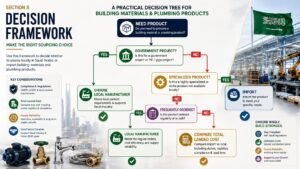
Why it matters: The right sourcing choice depends on the specific product, order pattern, and end buyer, not a blanket rule in either direction. A few questions consistently separate a well-reasoned decision from a price only one.

  • Is the product on, or likely to join, the LCGPA Mandatory List? If so, local sourcing may not just be preferable, it may become a procurement requirement for government-linked buyers.
  • What’s the true landed cost, not the unit price? Certification, testing, per-shipment documentation, and potential re-export risk all sit on top of the quoted import price.
  • How often is this product reordered? Recurring orders amplify the compliance overhead of importing far more than a single purchase does.
  • Does the end client require a Local Content Certificate as part of their own bid? If so, sourcing decisions further down the chain need to support that certificate, not work against it.
  • Is the local manufacturer actually certified to the standard the project needs? ISO certification and documented quality control matter regardless of which sourcing route is chosen.

What This Means for Kanzotech’s Position

Kanzotech manufactures water pumps, faucets, and building accessories in-house, under ISO-certified quality control, with distribution across Saudi Arabia. That puts us directly inside the product categories the LCGPA has now named on its Mandatory List, water pumps, water valves, and the plumbing fittings that sit alongside them, ahead of the requirement taking effect.

For buyers reassessing their sourcing mix, whether because of a specific government tender, a giga-project’s local content requirements, or simply the compounding cost of import certification, a Saudi-manufactured, pre-certified product line removes the per-shipment compliance cycle entirely. Our water pumps, faucets, and building accessories ranges are built and stocked for exactly this shift.

Practical Takeaways for Buyers

  • Check whether your regularly ordered products sit on the LCGPA Mandatory List, or are scheduled to join it, before your next procurement cycle.
  • Price in certification and compliance overhead, not just unit cost, when comparing an imported quote against a local one.
  • Ask government and giga-project end clients directly whether a Local Content Certificate is required as part of their own bid submission.
  • Reserve importing for genuinely specialized or low-frequency orders, where certification overhead is harder to justify against volume.
  • Evaluate local manufacturers on certification and track record, not assumption, since ISO compliance and documented quality control matter on either sourcing path.

Conclusion

The choice between importing and sourcing locally in Saudi Arabia isn’t disappearing, but it’s no longer a simple price comparison. With SASO and SABER certification now enforced per shipment, and the LCGPA naming water pumps, water valves, and other core building products directly on its Mandatory List, buyers who factor in the full compliance picture are making a more accurate decision than those comparing unit prices alone.

Your next steps:

  1. Review your current import product list against the LCGPA Mandatory List and its published timelines.
  2. Calculate the true landed cost of your most frequently imported products, including certification and per-shipment compliance.
  3. Confirm whether any government or giga-project clients you supply require a Local Content Certificate as part of their bids.
  4. Explore Kanzotech’s water pumps, faucets, and building accessories ranges as a locally manufactured, ISO-certified alternative.

Weighing your sourcing options for an upcoming project or tender? Contact Kanzotech to discuss what fits your requirements.

Comments

No comments yet. Be the first to comment!

Footer Logo

Let Life Flow With Us!

OFFICE LOCATION

Al Kolibi Tower,
King Saud Street
P.B No: 32426, Dammam,
Saudi Arabia

CONTACT

sales@kanzotech com

info@kanzotech.com

+966 55 981 0470

+966 54 750 9351