Green Riyadh Project: What Its Irrigation Infrastructure Means for Suppliers

POSTED BY: Hyzam Kanzo / August 11, 2026
Views
8 Views
0 Comments

Introduction

The Green Riyadh Project rarely gets the same attention as NEOM or the Red Sea Project. There is no futuristic skyline render here, no resort island. Instead, this is one of the four original giga-projects launched by King Salman in 2019, and its ambition is quieter but just as demanding on infrastructure. Riyadh wants to become one of the greenest capitals in the world, and that requires moving enormous volumes of treated water across the city, every single day, indefinitely.

That distinction matters for suppliers. Green Riyadh is not primarily a construction story. It is a water distribution story, and the pump, valve, and pipeline requirements behind it are substantial, recurring, and largely separate from the superstructure work most giga-project coverage focuses on.

Green Riyadh at a Glance

Green Riyadh is implemented by the Royal Commission for Riyadh City, RCRC, and centers on planting more than 7.5 million trees and shrubs across the capital by 2030. The programme spans afforestation along 1,204 kilometres of main roads, 43 city parks, 387 neighbourhood parks, thousands of mosques, schools, and government compounds, and 148 square kilometres of valleys and tributaries, including the ongoing rehabilitation of Wadi Hanifah, which RCRC refers to as the city’s green lung.

The stated target is to raise Riyadh’s per capita green space from 1.7 square metres to 28 square metres, and to lift green cover from roughly 1.5 percent toward 9.1 percent by 2030. As of mid-2026, RCRC has reported transformation work across more than 120 residential neighbourhoods, with localized cooling of 2 to 4 degrees Celsius recorded in heavily forested districts during peak summer.

None of this happens without water, and Riyadh’s water resources are scarce. That constraint is what shapes the entire infrastructure programme behind the trees.

Why Irrigation Infrastructure Is the Real Project

Why it matters: Unlike a residential or hospitality development, Green Riyadh’s core deliverable is not buildings. It is a permanent, citywide irrigation network, and that network is what determines whether the tree planting target is achievable at all.

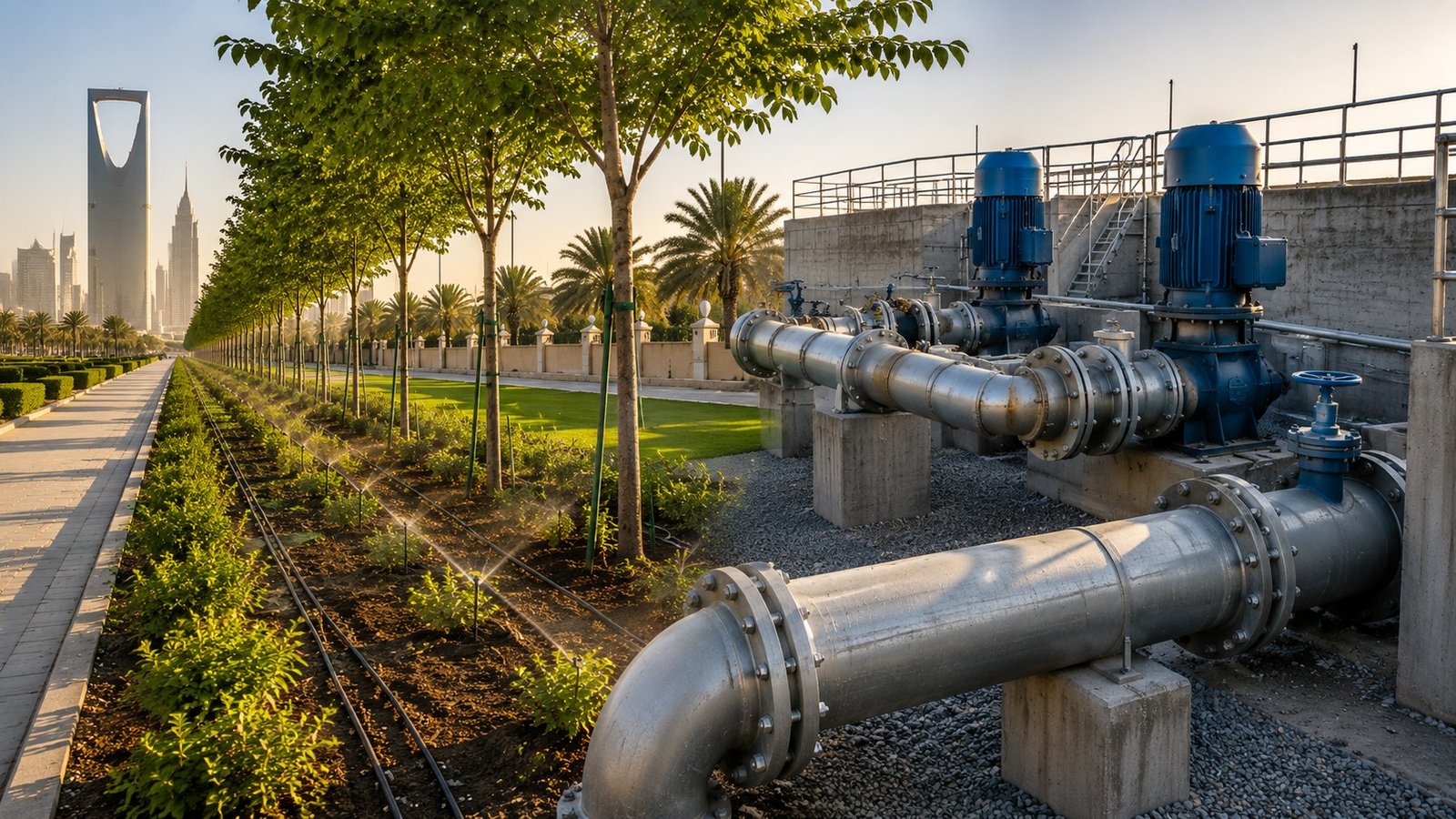
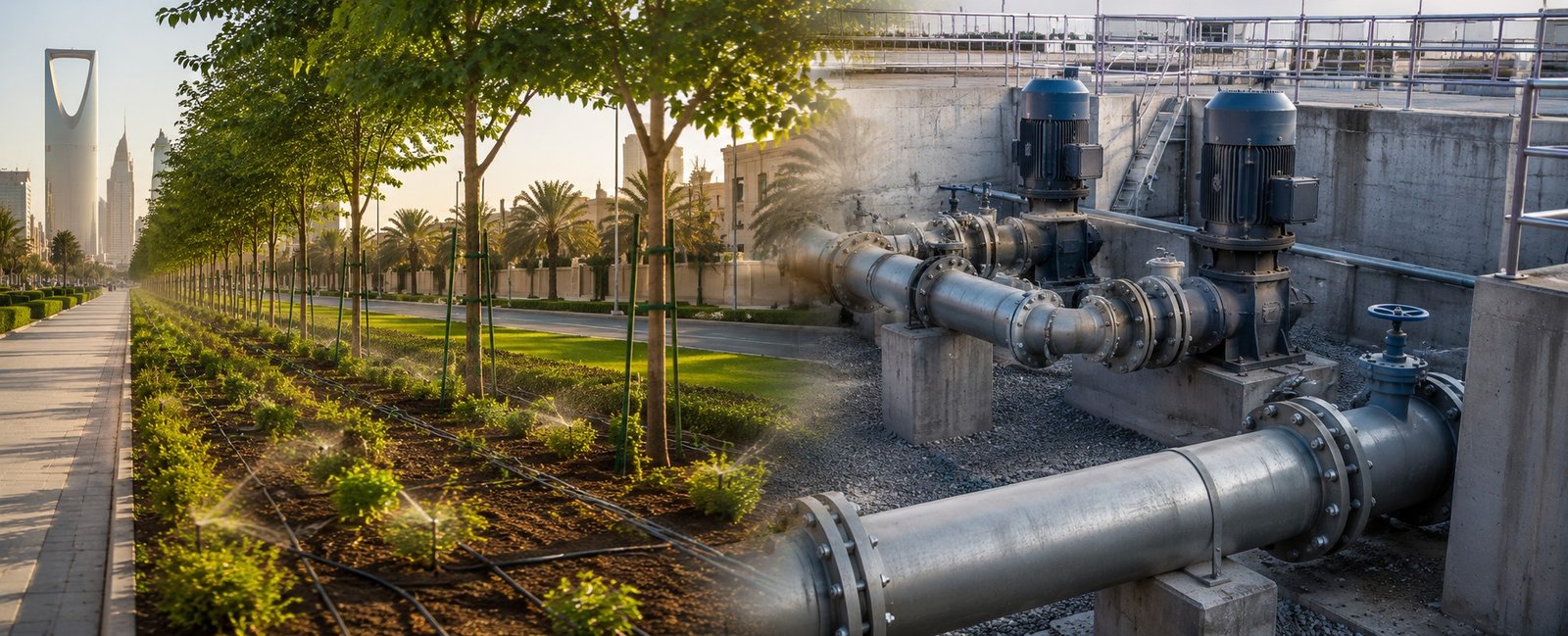
Treated wastewater, known locally as TSE, is the designated source for all Green Riyadh irrigation. Recycled water is transported from National Water Company treatment plants, including Manfuha, Heet, and Al Hair, through a dedicated underground distribution network built specifically to reach parks, road medians, and green corridors across the metropolitan area. Around 1 million cubic metres of treated water are already being used daily for irrigation under the current network.

A far larger expansion is now moving through procurement. A new treated sewage effluent transmission pipeline network, designed to carry up to 1.7 million cubic metres a day, was tendered in July 2026, with bid submissions due in November 2026 and contract award expected around March 2027. Project completion is targeted for the fourth quarter of 2029, with ILF providing project management consultancy. This is a multi-year, multi-billion riyal infrastructure programme running in parallel to the visible landscaping work most people associate with Green Riyadh.

Supporting infrastructure already under design and construction includes strategic concrete storage tanks, among them a 185,000 cubic metre tank at the Ministry of Health site, a 310,000 cubic metre tank at City Park, and a 180,000 cubic metre tank at the Zoo facility, alongside new pumping stations such as one at the Ministry of Health site rated at roughly 29,416 cubic metres per hour. Smart irrigation systems using real-time sensors are also being deployed to optimize watering based on weather conditions, reducing waste across the network.

Who Is Already Working on This

Why it matters: Green Riyadh’s water infrastructure is not a single mega-contract. It is split across design consultancies, treatment plant operators, and specialist water and wastewater contractors, and several of these relationships are already active.

  • National Water Company operates the source treatment plants, including the rehabilitated Manfuha complex, which carries a total capacity of 700,000 cubic metres a day.
  • Alkhorayef Water and Power Technologies holds active contracts covering pumping stations, transmission pipelines, and distribution systems, including a five-year SAR 65.59 million deal with the Saudi Irrigation Organisation covering treated water and groundwater pumping across Riyadh’s Central Sector, its suburbs, and Al Aflaj, alongside a separate 30-month sewage network contract with RCRC.
  • Egis has supported project management and species selection for the afforestation programme, working with RCRC on GIS-based planning tools.
  • ILF is currently engaged as project management consultant on the new TSE transmission pipeline tender.

For suppliers, the useful signal here is that Green Riyadh procurement is already fragmented across multiple specialist contractors rather than routed through one main works package, which means there are several active entry points rather than a single gate to get through.

What This Means for Pump and Valve Suppliers

Why it matters: The technical profile of Green Riyadh’s water infrastructure differs from a typical construction dewatering or building services scope, and suppliers positioning for it should understand what actually gets specified.

  • High-volume transmission pumping. Moving up to 1.7 million cubic metres of treated water a day across a citywide network requires transmission-grade pumps built for continuous duty, not intermittent construction use.
  • Treated wastewater compatibility. Pumps, valves, and fittings in this network handle TSE rather than potable or raw water, which places specific demands on materials and seals to manage water quality variation over a long service life.
  • Distributed pumping stations, not one central hub. With storage tanks and pumping infrastructure spread across multiple sites, including Ministry of Health, City Park, and Zoo facility locations, this favors suppliers who can support several concurrent, geographically spread installations rather than a single large delivery.
  • Irrigation-scale valves and distribution fittings. Beyond the transmission mains, the network feeding individual parks, road medians, and neighbourhood green spaces needs a high volume of smaller valves, control fittings, and distribution hardware, an area that rewards suppliers with genuinely broad catalogue depth.
  • A long operating horizon. With the network expansion targeted for completion in late 2029 and Green Riyadh itself running through 2030 and beyond, this is not a project with a fixed delivery date after which demand disappears. Irrigation infrastructure at this scale requires ongoing maintenance, replacement parts, and expansion capacity for years after initial construction.

What Makes a Supplier Ready for This Kind of Work

Why it matters: As covered in more depth in our piece on where NEOM’s giga-project spending actually stands, Saudi giga-project procurement increasingly rewards a specific supplier profile, and Green Riyadh’s water infrastructure programme is no exception.

  • In-house manufacturing, not resale. Long-running infrastructure programmes with multiple procurement phases favour suppliers who control their own production and can guarantee consistent specification across years of orders.
  • Certified quality standards. ISO certification and documented quality control are baseline expectations for any supplier working with National Water Company or RCRC-linked contractors.
  • A genuinely broad product range. Consolidating pumps, valves, and fittings under one supplier reduces coordination overhead for contractors managing multi-site pumping and distribution work.
  • Local stock and nationwide delivery. With infrastructure spread across the Riyadh metropolitan area and into suburbs and Al Aflaj, a supplier with strong Riyadh-area distribution backed by a wider national network is well positioned to support phased rollout without material gaps.
  • A track record with utility and irrigation contractors. Existing relationships with firms already active in Saudi water and wastewater infrastructure carry real weight when new procurement phases open.

The Local Content Angle

Why it matters: Green Riyadh sits inside the same Vision 2030 local content push shaping procurement across the Kingdom’s giga-projects, overseen by the Local Content and Government Procurement Authority.

Saudi Arabia’s water and sanitation market is projected to grow from roughly USD 10.4 billion in 2023 to USD 16.2 billion by 2030, and government spending on water and sanitation tenders now exceeds USD 2.8 billion a year. For suppliers weighing whether to expand local manufacturing capacity rather than continuing to import and resell, a programme with a confirmed multi-year procurement pipeline like Green Riyadh’s TSE network expansion makes that investment case considerably stronger.

Practical Takeaways for Suppliers

  • Track the TSE transmission pipeline tender closely. With bids due in November 2026 and award expected around March 2027, the subcontracting and equipment supply chain around this contract will start forming well before the main award is announced.
  • Build relationships with active O&M contractors now. Companies already holding pumping and distribution contracts, such as Alkhorayef, are a more direct route into ongoing supply opportunities than waiting for new headline contract announcements.
  • Position for treated wastewater applications specifically. Product positioning built around potable water or construction dewatering does not automatically translate to TSE network requirements.
  • Plan for distributed, multi-site delivery. Green Riyadh’s pumping and storage infrastructure spans multiple locations across the city, which favours suppliers with logistics capacity to support several sites at once.
  • Treat this as a long-term irrigation infrastructure relationship, not a single order. The network is designed to keep expanding through 2029 and to operate indefinitely afterward.

Conclusion

Green Riyadh is easy to underestimate because its visible output is trees and parks rather than towers. Underneath that is a citywide treated water transmission and pumping network worth billions of riyals, with a major expansion currently moving through procurement and years of ongoing operation ahead of it. For pump, valve, and water infrastructure suppliers, that combination of confirmed budget, active tendering, and long operating horizon makes it one of the more dependable irrigation infrastructure opportunities in the Kingdom’s current giga-project pipeline.

Your next steps:

  1. Track the Green Riyadh TSE transmission pipeline tender through its November 2026 bid deadline and expected March 2027 award.
  2. Identify which O&M and water infrastructure contractors are already active on Riyadh’s treated water and irrigation contracts.
  3. Review product positioning for treated wastewater compatibility rather than potable water or construction dewatering use cases.
  4. Explore Kanzotech’s centrifugal pumps, submersible pumps, and full water pumps range to see how an in-house manufactured, ISO certified product line fits into long-term urban irrigation infrastructure supply.

Looking to source pumps or water distribution equipment for a large-scale infrastructure project? Contact Kanzotech to discuss your project’s requirements.

Comments

No comments yet. Be the first to comment!

Your comments are valuable

Blog Detail Image

Green Riyadh Project: What Its Irrigation Infrastructure Means for Suppliers

POSTED BY: Hyzam Kanzo / 11 August 2026
8 Views
0 Comments

Introduction

The Green Riyadh Project rarely gets the same attention as NEOM or the Red Sea Project. There is no futuristic skyline render here, no resort island. Instead, this is one of the four original giga-projects launched by King Salman in 2019, and its ambition is quieter but just as demanding on infrastructure. Riyadh wants to become one of the greenest capitals in the world, and that requires moving enormous volumes of treated water across the city, every single day, indefinitely.

That distinction matters for suppliers. Green Riyadh is not primarily a construction story. It is a water distribution story, and the pump, valve, and pipeline requirements behind it are substantial, recurring, and largely separate from the superstructure work most giga-project coverage focuses on.

Green Riyadh at a Glance

Green Riyadh is implemented by the Royal Commission for Riyadh City, RCRC, and centers on planting more than 7.5 million trees and shrubs across the capital by 2030. The programme spans afforestation along 1,204 kilometres of main roads, 43 city parks, 387 neighbourhood parks, thousands of mosques, schools, and government compounds, and 148 square kilometres of valleys and tributaries, including the ongoing rehabilitation of Wadi Hanifah, which RCRC refers to as the city’s green lung.

The stated target is to raise Riyadh’s per capita green space from 1.7 square metres to 28 square metres, and to lift green cover from roughly 1.5 percent toward 9.1 percent by 2030. As of mid-2026, RCRC has reported transformation work across more than 120 residential neighbourhoods, with localized cooling of 2 to 4 degrees Celsius recorded in heavily forested districts during peak summer.

None of this happens without water, and Riyadh’s water resources are scarce. That constraint is what shapes the entire infrastructure programme behind the trees.

Why Irrigation Infrastructure Is the Real Project

Why it matters: Unlike a residential or hospitality development, Green Riyadh’s core deliverable is not buildings. It is a permanent, citywide irrigation network, and that network is what determines whether the tree planting target is achievable at all.

Treated wastewater, known locally as TSE, is the designated source for all Green Riyadh irrigation. Recycled water is transported from National Water Company treatment plants, including Manfuha, Heet, and Al Hair, through a dedicated underground distribution network built specifically to reach parks, road medians, and green corridors across the metropolitan area. Around 1 million cubic metres of treated water are already being used daily for irrigation under the current network.

A far larger expansion is now moving through procurement. A new treated sewage effluent transmission pipeline network, designed to carry up to 1.7 million cubic metres a day, was tendered in July 2026, with bid submissions due in November 2026 and contract award expected around March 2027. Project completion is targeted for the fourth quarter of 2029, with ILF providing project management consultancy. This is a multi-year, multi-billion riyal infrastructure programme running in parallel to the visible landscaping work most people associate with Green Riyadh.

Supporting infrastructure already under design and construction includes strategic concrete storage tanks, among them a 185,000 cubic metre tank at the Ministry of Health site, a 310,000 cubic metre tank at City Park, and a 180,000 cubic metre tank at the Zoo facility, alongside new pumping stations such as one at the Ministry of Health site rated at roughly 29,416 cubic metres per hour. Smart irrigation systems using real-time sensors are also being deployed to optimize watering based on weather conditions, reducing waste across the network.

Who Is Already Working on This

Why it matters: Green Riyadh’s water infrastructure is not a single mega-contract. It is split across design consultancies, treatment plant operators, and specialist water and wastewater contractors, and several of these relationships are already active.

  • National Water Company operates the source treatment plants, including the rehabilitated Manfuha complex, which carries a total capacity of 700,000 cubic metres a day.
  • Alkhorayef Water and Power Technologies holds active contracts covering pumping stations, transmission pipelines, and distribution systems, including a five-year SAR 65.59 million deal with the Saudi Irrigation Organisation covering treated water and groundwater pumping across Riyadh’s Central Sector, its suburbs, and Al Aflaj, alongside a separate 30-month sewage network contract with RCRC.
  • Egis has supported project management and species selection for the afforestation programme, working with RCRC on GIS-based planning tools.
  • ILF is currently engaged as project management consultant on the new TSE transmission pipeline tender.

For suppliers, the useful signal here is that Green Riyadh procurement is already fragmented across multiple specialist contractors rather than routed through one main works package, which means there are several active entry points rather than a single gate to get through.

What This Means for Pump and Valve Suppliers

Why it matters: The technical profile of Green Riyadh’s water infrastructure differs from a typical construction dewatering or building services scope, and suppliers positioning for it should understand what actually gets specified.

  • High-volume transmission pumping. Moving up to 1.7 million cubic metres of treated water a day across a citywide network requires transmission-grade pumps built for continuous duty, not intermittent construction use.
  • Treated wastewater compatibility. Pumps, valves, and fittings in this network handle TSE rather than potable or raw water, which places specific demands on materials and seals to manage water quality variation over a long service life.
  • Distributed pumping stations, not one central hub. With storage tanks and pumping infrastructure spread across multiple sites, including Ministry of Health, City Park, and Zoo facility locations, this favors suppliers who can support several concurrent, geographically spread installations rather than a single large delivery.
  • Irrigation-scale valves and distribution fittings. Beyond the transmission mains, the network feeding individual parks, road medians, and neighbourhood green spaces needs a high volume of smaller valves, control fittings, and distribution hardware, an area that rewards suppliers with genuinely broad catalogue depth.
  • A long operating horizon. With the network expansion targeted for completion in late 2029 and Green Riyadh itself running through 2030 and beyond, this is not a project with a fixed delivery date after which demand disappears. Irrigation infrastructure at this scale requires ongoing maintenance, replacement parts, and expansion capacity for years after initial construction.

What Makes a Supplier Ready for This Kind of Work

Why it matters: As covered in more depth in our piece on where NEOM’s giga-project spending actually stands, Saudi giga-project procurement increasingly rewards a specific supplier profile, and Green Riyadh’s water infrastructure programme is no exception.

  • In-house manufacturing, not resale. Long-running infrastructure programmes with multiple procurement phases favour suppliers who control their own production and can guarantee consistent specification across years of orders.
  • Certified quality standards. ISO certification and documented quality control are baseline expectations for any supplier working with National Water Company or RCRC-linked contractors.
  • A genuinely broad product range. Consolidating pumps, valves, and fittings under one supplier reduces coordination overhead for contractors managing multi-site pumping and distribution work.
  • Local stock and nationwide delivery. With infrastructure spread across the Riyadh metropolitan area and into suburbs and Al Aflaj, a supplier with strong Riyadh-area distribution backed by a wider national network is well positioned to support phased rollout without material gaps.
  • A track record with utility and irrigation contractors. Existing relationships with firms already active in Saudi water and wastewater infrastructure carry real weight when new procurement phases open.

The Local Content Angle

Why it matters: Green Riyadh sits inside the same Vision 2030 local content push shaping procurement across the Kingdom’s giga-projects, overseen by the Local Content and Government Procurement Authority.

Saudi Arabia’s water and sanitation market is projected to grow from roughly USD 10.4 billion in 2023 to USD 16.2 billion by 2030, and government spending on water and sanitation tenders now exceeds USD 2.8 billion a year. For suppliers weighing whether to expand local manufacturing capacity rather than continuing to import and resell, a programme with a confirmed multi-year procurement pipeline like Green Riyadh’s TSE network expansion makes that investment case considerably stronger.

Practical Takeaways for Suppliers

  • Track the TSE transmission pipeline tender closely. With bids due in November 2026 and award expected around March 2027, the subcontracting and equipment supply chain around this contract will start forming well before the main award is announced.
  • Build relationships with active O&M contractors now. Companies already holding pumping and distribution contracts, such as Alkhorayef, are a more direct route into ongoing supply opportunities than waiting for new headline contract announcements.
  • Position for treated wastewater applications specifically. Product positioning built around potable water or construction dewatering does not automatically translate to TSE network requirements.
  • Plan for distributed, multi-site delivery. Green Riyadh’s pumping and storage infrastructure spans multiple locations across the city, which favours suppliers with logistics capacity to support several sites at once.
  • Treat this as a long-term irrigation infrastructure relationship, not a single order. The network is designed to keep expanding through 2029 and to operate indefinitely afterward.

Conclusion

Green Riyadh is easy to underestimate because its visible output is trees and parks rather than towers. Underneath that is a citywide treated water transmission and pumping network worth billions of riyals, with a major expansion currently moving through procurement and years of ongoing operation ahead of it. For pump, valve, and water infrastructure suppliers, that combination of confirmed budget, active tendering, and long operating horizon makes it one of the more dependable irrigation infrastructure opportunities in the Kingdom’s current giga-project pipeline.

Your next steps:

  1. Track the Green Riyadh TSE transmission pipeline tender through its November 2026 bid deadline and expected March 2027 award.
  2. Identify which O&M and water infrastructure contractors are already active on Riyadh’s treated water and irrigation contracts.
  3. Review product positioning for treated wastewater compatibility rather than potable water or construction dewatering use cases.
  4. Explore Kanzotech’s centrifugal pumps, submersible pumps, and full water pumps range to see how an in-house manufactured, ISO certified product line fits into long-term urban irrigation infrastructure supply.

Looking to source pumps or water distribution equipment for a large-scale infrastructure project? Contact Kanzotech to discuss your project’s requirements.

Comments

No comments yet. Be the first to comment!

Footer Logo

Let Life Flow With Us!

OFFICE LOCATION

Al Kolibi Tower,
King Saud Street
P.B No: 32426, Dammam,
Saudi Arabia

CONTACT

sales@kanzotech com

info@kanzotech.com

+966 55 981 0470

+966 54 750 9351