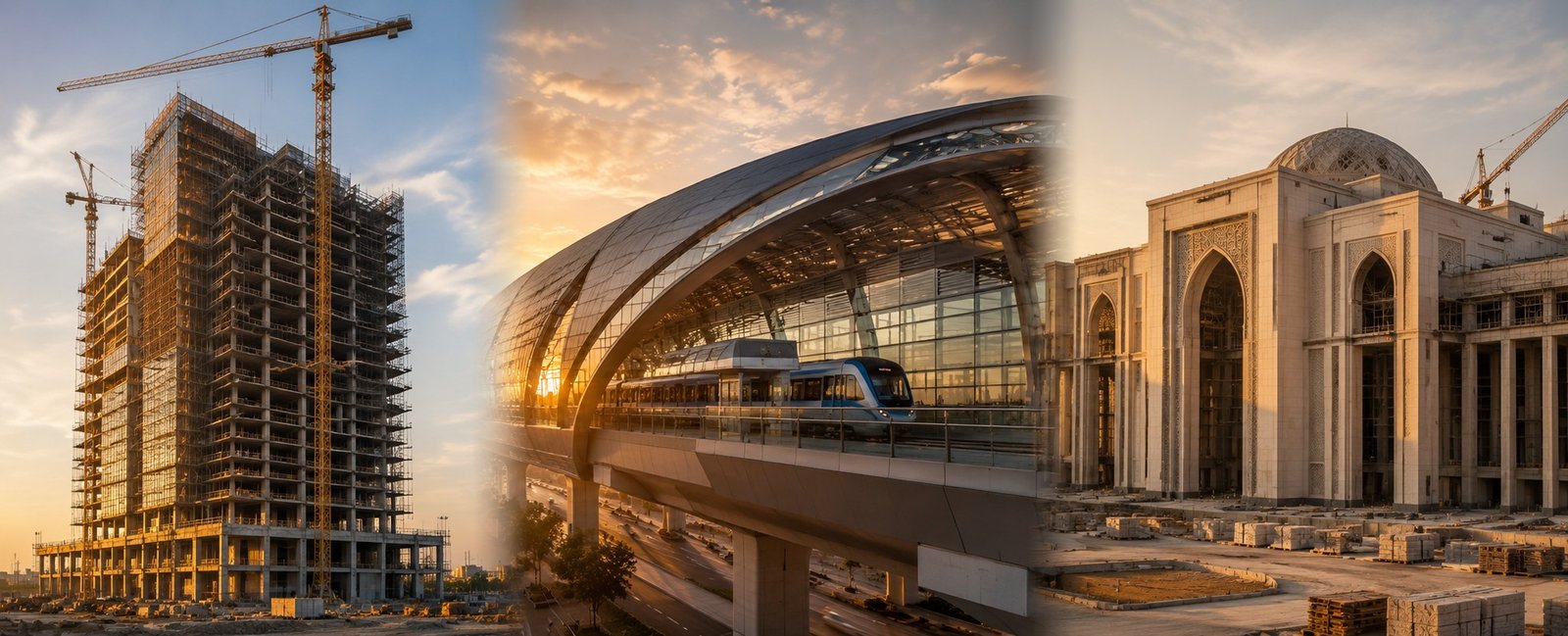


Top Contractors in Saudi Arabia 2026: Where the Real Work Is Now


Introduction
Knowing which developer announced a project is one thing. Knowing which contractor is actually pouring concrete, running MEP risers, and specifying fixtures is a different, more useful piece of information if you’re a supplier trying to figure out where real, near-term demand is concentrated.
Saudi Arabia’s contracting landscape in 2026 is dominated by a handful of firms with decades of track record and current backlogs worth billions of riyals. This piece breaks down who’s actually building the Kingdom right now, what kind of work each one specializes in, and what that specialization means for pump, valve, and faucet suppliers trying to read where the real opportunity sits.
Who’s Actually Building Saudi Arabia Right Now
Why it matters: Saudi Arabia’s construction sector currently supports more than 5,200 active projects nationwide, with a combined value estimated north of $800 billion, and a relatively small group of established contractors handles a disproportionate share of the Kingdom’s largest, most technically complex work.
The names that consistently top industry rankings in 2026 include Saudi Binladin Group, Nesma & Partners, El Seif Engineering Contracting, Almabani General Contractors, Al Bawani Holding, Alfanar Construction, Al Ayuni Investment & Contracting, and Saudi Arabian Baytur Construction Company, among others. Each has carved out a distinct specialization, and those specializations point directly to where different categories of MEP demand are concentrated.
Religious and National Megaprojects: Saudi Binladin Group’s Domain
Why it matters: Saudi Binladin Group is the Kingdom’s oldest and most historically significant contractor, with a track record dating back to 1931 and a legacy that includes the Grand Mosque expansion in Makkah and King Abdulaziz International Airport. This category of work carries MEP requirements unlike almost anything else in the construction sector.
What this means for suppliers: Religious and pilgrimage-related megaprojects involve water infrastructure at a scale most commercial projects never approach, ablution and wudu facilities serving enormous, concentrated visitor volumes, continuous-duty water distribution systems built for sustained peak demand during pilgrimage seasons, and fixture specifications that need to perform reliably under some of the highest usage frequencies of any building type in the Kingdom. Suppliers of high-durability faucets, hand spray fittings, and large-scale pump systems have a genuine, specialized opportunity in this category, though it demands equipment built for a usage intensity well beyond standard commercial specifications.
Metro, Airports, and Transport: Almabani and Nesma’s Territory
Why it matters: Almabani General Contractors, founded in 1972 and now employing more than 12,000 people, has built its reputation on exactly this category, with direct involvement in the Riyadh Metro, Red Sea International Airport, and the King Abdulaziz International Airport expansion. Nesma & Partners has a similarly strong footprint in transportation and energy infrastructure, including its own role in the KAIA expansion.
What this means for suppliers: Transit and aviation infrastructure demands MEP systems built for continuous, high-volume public use, large-scale valve and flow control systems, fire suppression infrastructure across sprawling terminal and station footprints, and public restroom and utility fixture specifications sized for passenger volumes rather than typical building occupancy. This segment rewards suppliers who can support large, standardized fixture orders across multiple stations or terminal zones consistently, since project scale here is measured in hundreds of connected points, not dozens.
High-Rise and Cultural Landmarks: El Seif’s Specialty
Why it matters: El Seif Engineering Contracting, part of the wider El Seif Group with nearly five decades of standalone track record, built Riyadh’s 302-metre Kingdom Tower and several towers within the King Abdullah Financial District, and is currently working on the Diriyah Royal Opera House as part of the Diriyah Gate cultural district. El Seif is also one of four contractors backed directly by a $1.3 billion PIF investment, positioning it centrally in the Kingdom’s ongoing giga-project delivery.
What this means for suppliers: High-rise construction demands serious booster pump engineering, since standard municipal water pressure can’t reliably serve upper floors on a building of this scale, along with complex, zoned water distribution systems managing dozens of pressure zones within a single structure. Cultural landmark projects like an opera house add a further layer, luxury-grade faucets and fixtures where finish quality and consistency matter as much as function, closer in specification to hospitality-grade work than standard commercial building.
The Broad, Turnkey Model: Al Bawani’s Approach
Why it matters: Al Bawani Holding, founded in 1991 and now a top Class-1 general contractor with more than 250 completed projects and a workforce above 12,000, takes a different approach than the specialists above, working turnkey and keeping much of its construction capability in-house across infrastructure, commercial, industrial, residential, healthcare, and institutional sectors simultaneously.
What this means for suppliers: This kind of broad, multi-sector contractor represents a different opportunity profile entirely, not one massive, highly specialized project, but consistent, recurring MEP fixture demand spread across many concurrent projects of varying scale. Suppliers able to support breadth, standardized product lines across healthcare, residential, and institutional specifications simultaneously, are better positioned to serve a contractor like this than suppliers built around a single, narrow specialty.
Where Kanzotech Already Sits in This Landscape
Two names on this list are already part of Kanzotech’s existing client base: Alfanar and Saudi Arabian Baytur Construction Company, the latter also directly engaged in AMAALA’s Triple Bay Marina Village and Yacht Club construction, as covered in our earlier piece on what the Red Sea Project and AMAALA mean for suppliers. That overlap reflects the same dynamic running through this entire piece: real supply relationships with Saudi Arabia’s top contractors translate directly into material presence across the Kingdom’s highest-profile projects.
What This Means for Pump, Valve, and Faucet Suppliers, Segment by Segment

Practical Takeaways for Suppliers
- Match your product strengths to the right contractor segment, rather than pursuing every major contractor with the same generic pitch. A supplier strong in high-durability, high-volume fixtures fits Saudi Binladin Group’s world far better than El Seif’s luxury cultural landmark work, and vice versa.
- Watch for existing overlap in your own client base. As covered above, real supply relationships with contractors already active on major projects, like Kanzotech’s ties to Alfanar and Baytur, are a stronger predictor of future opportunity than cold outreach to a name on a ranking list.
- Prioritize standardization for turnkey, multi-sector contractors. Firms like Al Bawani reward suppliers who can support consistent specifications across many concurrent, varied projects rather than a single bespoke order.
- Prepare for extreme-duty specifications when targeting religious and megaproject work. Standard commercial-grade fixtures and pump systems generally aren’t built for the sustained, high-volume demand this category requires.
Conclusion
Saudi Arabia’s top contractors each occupy a distinct lane, religious and national megaprojects, transit and aviation infrastructure, high-rise and cultural landmarks, and broad, multi-sector turnkey delivery, and each lane carries genuinely different MEP and fixture requirements. For pump, valve, and faucet suppliers, reading these segments accurately, and recognizing which one actually matches your product strengths, is a far more useful starting point than treating every major contractor as an identical target.
Your next steps:
- Map your product range against the contractor segment it’s actually best suited to, rather than a generic pitch across every major name.
- Review your existing client relationships for overlap with contractors active on current giga-projects.
- Explore Kanzotech’s combined water pumps, faucets, and plumbing materials and valves ranges as a single-source supply partner across multiple contractor segments and project types.
Looking to align your supply capability with the right segment of Saudi Arabia’s contractor landscape? Contact Kanzotech to discuss your product range and project fit.











Comments
No comments yet. Be the first to comment!