NEOM in 2026: What’s Real, What’s Delayed, and What It Means for Suppliers

POSTED BY: Hyzam Kanzo / June 29, 2026
Views
350 Views
0 Comments

Introduction

We almost didn’t write this post. Not because NEOM isn’t worth covering, it’s probably the single most talked about Vision 2030 project outside the Kingdom but because the easy version of this article would have been wrong. The easy version leans on the original renderings, the $500 billion figure, the mirrored skyscrapers, and calls it a day. That version doesn’t match what’s actually happened over the past year.

We supply pumps, faucets, fittings, and accessories to contractors across Saudi Arabia, and our credibility with that audience depends on getting the facts right, including the inconvenient ones. So here’s our honest read on where NEOM actually stands in 2026: what’s been built, what’s been pulled back, and what we think it means if you’re trying to figure out whether NEOM is worth your attention as a commercial opportunity right now.

What NEOM was supposed to be

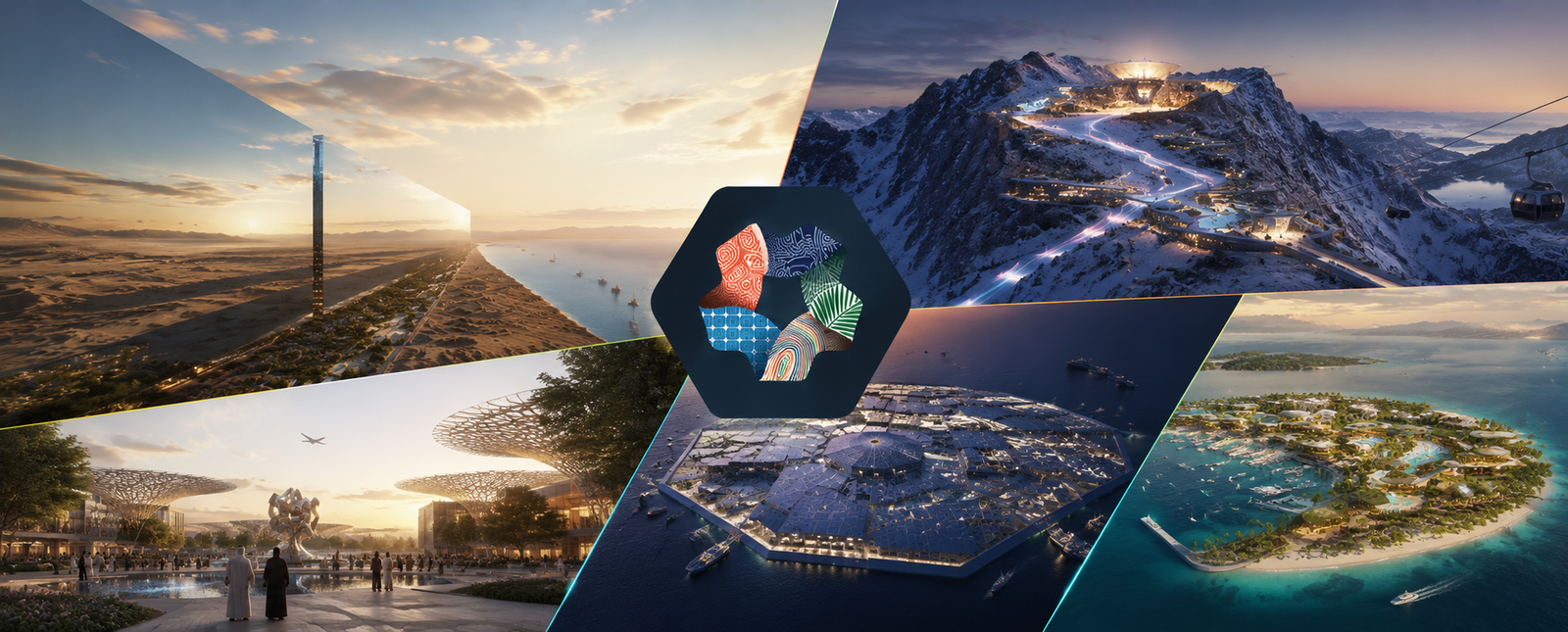
NEOM was announced in 2017 as part of Vision 2030 , a roughly $500 billion development in Saudi Arabia’s northwest Tabuk province, covering an area about the size of Belgium. The plan split it into several distinct zones, each with its own leadership and budget: The Line (a 170-kilometer linear city), Oxagon (a floating industrial port), Trojena (a mountain ski resort), Sindalah (a luxury island), and NEOM Bay (the administrative and airport hub).

At full ambition, The Line alone was meant to house up to 9 million people by 2045, packed in at a density roughly six times that of Manila, currently the world’s most crowded city. That’s the version most people still picture when they hear the name NEOM. It’s not the version that exists right now.

The Line: suspended, and quietly being redesigned

The Line was always the centerpiece, and it’s also where the gap between promise and reality is widest.

Construction was officially suspended by Saudi Arabia’s Public Investment Fund in September 2025, and as far as we can tell from the latest reporting, work hasn’t resumed. Before the suspension, the project had completed around 2.4 kilometers of foundation, out of a planned 170. That’s roughly 1.4% of the total length. The structural steelwork hasn’t gone in, and the mirrored glass cladding that made The Line so visually distinctive still exists only in renders.

The financial story behind that suspension is genuinely jaw-dropping. An internal audit reportedly leaked to the Wall Street Journal in early 2025 put the cost of finishing The Line to its original spec at around $8.8 trillion, not billion , with a completion date stretching to 2080. Saudi’s PIF wrote down $8 billion tied to the project not long after. As of May 2026, reporting indicates the project has been pushed back until at least 2030, with NEOM working on a redesign of the signature twin towers to bring costs down.

The population targets tell the same story in smaller numbers. NEOM once talked about 1.5 million residents by 2030. That dropped to 300,000 a couple of years back, and has since been cut again, to as few as 100,000. Workforce numbers have followed suit, NEOM job postings reportedly fell by around 75% through 2025, and over a thousand staff were relocated from the remote site to offices in Riyadh.

We want to be careful about what this does and doesn’t mean. Saudi officials describe this as “phased delivery.” Industry watchers and contractor filings suggest the full 170 kilometer version is indefinitely shelved rather than formally cancelled. Reporting also suggests Crown Prince Mohammed bin Salman has privately accepted the project will end up “far smaller” than first announced. Nobody outside the project really knows yet whether that means a scaled-down permanent version, or a pause before a return to something closer to the original scope.

Trojena: lost its headline event, lost billions in contracts

Trojena, NEOM’s planned year-round ski and mountain resort was meant to host the 2029 Asian Winter Games. That deadline mattered for more than scheduling; it was the thing forcing sustained investment and attention onto the project.

It’s gone now. On January 24, 2026, the Olympic Council of Asia and the Saudi Olympic and Paralympic Committee jointly announced the Games were indefinitely postponed, with Almaty, Kazakhstan stepping in to host instead, date still unconfirmed. The trade press had already flagged construction delays and budget shortfalls at Trojena through 2025, so the postponement wasn’t exactly a shock.

What followed was a real financial hit. NEOM reportedly cancelled three major Trojena-linked contracts worth more than $6 billion combined , a $4.7 billion dam and lake project held by Webuild, a structural steel contract for the ski village held by Eversendai, and a separate $1 billion tunnel contract tied to The Line, held by Hyundai. Without the Games as a fixed deadline, Trojena has lost the clearest reason it had to keep attracting fresh investment.

Sindalah: the one we genuinely can’t pin down

We want to flag something honestly here rather than smoothing it over: the reporting on Sindalah, NEOM’s luxury Red Sea island resort, contradicts itself depending on which source you read, and we haven’t been able to fully reconcile it.

Some coverage from late 2025 describes Sindalah as on track for a soft opening later in 2026 , a relatively modest project at roughly $4 billion, with marina infrastructure, hotels, and villas, and a “grand opening” event already held back in October 2024. Other reporting from around the same window says Sindalah remains closed to the public despite that 2024 event, and is being transferred to a different management entity entirely. One independent analysis we came across scores it in a “critical risk” category, despite its comparatively simple build profile next to The Line or Trojena.

We’re not going to pretend we know which version is right. If you’re making a business decision that depends specifically on Sindalah’s timeline, treat it as unresolved rather than confirmed either way, and check for more recent reporting before committing to anything.

Oxagon’s green hydrogen plant: the most solid thing in the whole portfolio

If there’s one part of NEOM we’d point to as genuinely real, well funded, and close to done, it’s the green hydrogen facility at Oxagon.

NEOM Green Hydrogen Company, an equal joint venture between NEOM, ACWA Power, and Air Products is building what’s described as the world’s largest commercial scale green hydrogen plant. It reached financial close back in 2023 at $8.4 billion, with $6.1 billion of that as non-recourse financing from 23 banks and institutions, and a 30-year offtake agreement already locked in for everything it produces.

The physical progress checks out across multiple independent sources, which is more than we can say for some of NEOM’s other components. As of late 2025, reports citing NGHC put the project at 90% complete across all sites, 257 wind turbines, a solar farm the size of Manhattan, and a transmission grid built to carry 4 gigawatts of renewable power. More recent reporting from early 2026 confirms the project remains on schedule, with full renewable generation capacity targeted for mid-2026 and first green ammonia production expected in 2027.

Once running, the plant is designed to produce 600 tonnes of carbon free hydrogen daily, converted to green ammonia for export, saving an estimated 5 million tonnes of CO2 a year. Air Products holds the exclusive offtake rights, with most of the output headed to European industrial customers under decade-long agreements.

The broader Oxagon zone around the hydrogen plant hasn’t fared quite as well, the original vision of a fully floating octagonal industrial city has reportedly been scaled down to a more standard coastal industrial park, and parts of it have been pushed into the early 2030s without a confirmed construction start. But the hydrogen plant itself appears to be running on its own funding and timeline, separate from that broader uncertainty. NEOM has also reportedly signed a roughly $5 billion data center partnership with DataVolt, suggesting the project’s capital is increasingly flowing toward industrial and digital infrastructure rather than the original residential vision.

NEOM Bay: unglamorous, and that’s the point

NEOM Bay, the project’s administrative and airport hub, hasn’t generated headlines, mostly because it doesn’t need to. The airport is operational for construction flights and private aviation, with commercial service planned once demand catches up. Roads, utilities, and basic commercial buildings have gone in steadily. It’s the least exciting part of NEOM and also, by most accounts, the most straightforwardly on-track.

The money, zoomed out

Step back from any individual sub-project and the overall financial picture has shifted substantially. Saudi’s PIF reportedly cut its active NEOM construction commitments from around $71 billion to about $30 billion, a 60% reduction as capital moved toward fixed-deadline priorities like FIFA 2034 stadiums and Expo 2030 preparation in Riyadh. NEOM doesn’t have an externally imposed deadline anymore, especially after losing the Asian Winter Games, and that appears to have cost it priority against projects that do.

Total spending across all of NEOM through early 2026 sits somewhere around $40-60 billion, a huge number on its own, but a fraction of the $500 billion-plus originally floated. Softer oil prices and regional conflict-related costs have added to the pressure on Saudi Arabia’s broader giga-project spending during this period, which only sharpens the question of which commitments get funded on schedule and which get pushed.

What we’d tell a contractor or supplier looking at NEOM right now

Here’s where we land, having gone through all of the above.

Don’t treat “NEOM” as one opportunity. That’s the single biggest mistake we’d flag. The Oxagon hydrogen plant and The Line are not the same bet, and shouldn’t get the same level of confidence. One’s well-funded and 90% built. The other has no confirmed restart date.

The industrial and energy side looks like the safer near-term opportunity. Oxagon’s hydrogen plant and NEOM’s apparent pivot toward data centers and industrial infrastructure seem to be where the steady money is actually going right now. If your product line serves industrial or energy infrastructure rather than residential fit-out, that’s probably where to focus first.

Residential and tourism-linked opportunities carry real timeline risk. The Line, Trojena, and Sindalah all have unresolved questions hanging over them right now, a redesign here, a cancelled event there, conflicting reports elsewhere. If you’re planning inventory or capacity around any of these specifically, build in a wide margin of uncertainty.

NEOM isn’t going away, even in the rougher scenarios. An estimated $40-60 billion already spent is real, built infrastructure that nobody’s simply going to abandon, even if the original mega-city vision ends up smaller and slower than promised.

Worth tracking going forward: whether The Line gets a construction restart, whether Oxagon attracts investment beyond the hydrogen plant specifically, and whether the 2027 green ammonia export target holds. Those three things will tell you a lot about which direction this recalibration is heading next.

Why we’re not sugar coating this

We could have written a version of this post that stuck to the original $500 billion vision and skipped the suspension, the write-downs, and the cancelled contracts. It would read better. It would also be the kind of thing any contractor or procurement officer with even passing familiarity with NEOM’s recent coverage would catch immediately and once a supplier’s content gets caught being wrong or conveniently selective on a major regional project, that’s a hard reputation to walk back.

We’d rather be the supplier that gets the facts right, even when they’re not flattering. We supply water pumps, faucets, fittings, and building accessories to contractors and developers across Saudi Arabia, and that business runs on being seen as genuinely informed about this market, not just enthusiastic about it. Take a look at our water pumps, faucets, and building accessories ranges, or get in touch if you’re sourcing for a project anywhere in the Kingdom.

Where this leaves us

NEOM in 2026 isn’t the project announced in 2017, and it’s still actively in motion rather than settled. The clearest bright spot is the Oxagon hydrogen plant, tracking toward operational status in 2027 largely on schedule. The clearest setback is The Line, now delayed past 2030 and getting redesigned. Everything else , Trojena, Sindalah, the rest of Oxagon , sits somewhere in between, with real uncertainty attached to each.

Our take: don’t write NEOM off, and don’t treat it as business as usual either. Track each piece on its own evidence, weight your near-term decisions toward the parts with the strongest track record so far, and stay genuinely current, this story is still moving.

“This article was researched and written by the Kanzotech editorial team using reporting from Semafor, House of Saud, The Middle East Insider, Euronews, Domus, Newsweek, Oil & Gas Middle East, NEOM Green Hydrogen Company, Air Products, and RP Realty Plus. We update this page as new developments are reported , last reviewed June 2026.”

Comments

No comments yet. Be the first to comment!

Your comments are valuable

Blog Detail Image

NEOM in 2026: What’s Real, What’s Delayed, and What It Means for Suppliers

POSTED BY: Hyzam Kanzo / 29 June 2026
350 Views
0 Comments

Introduction

We almost didn’t write this post. Not because NEOM isn’t worth covering, it’s probably the single most talked about Vision 2030 project outside the Kingdom but because the easy version of this article would have been wrong. The easy version leans on the original renderings, the $500 billion figure, the mirrored skyscrapers, and calls it a day. That version doesn’t match what’s actually happened over the past year.

We supply pumps, faucets, fittings, and accessories to contractors across Saudi Arabia, and our credibility with that audience depends on getting the facts right, including the inconvenient ones. So here’s our honest read on where NEOM actually stands in 2026: what’s been built, what’s been pulled back, and what we think it means if you’re trying to figure out whether NEOM is worth your attention as a commercial opportunity right now.

What NEOM was supposed to be
NEOM was announced in 2017 as part of Vision 2030 , a roughly $500 billion development in Saudi Arabia’s northwest Tabuk province, covering an area about the size of Belgium. The plan split it into several distinct zones, each with its own leadership and budget: The Line (a 170-kilometer linear city), Oxagon (a floating industrial port), Trojena (a mountain ski resort), Sindalah (a luxury island), and NEOM Bay (the administrative and airport hub).

At full ambition, The Line alone was meant to house up to 9 million people by 2045, packed in at a density roughly six times that of Manila, currently the world’s most crowded city. That’s the version most people still picture when they hear the name NEOM. It’s not the version that exists right now.

The Line: suspended, and quietly being redesigned

The Line was always the centerpiece, and it’s also where the gap between promise and reality is widest.

Construction was officially suspended by Saudi Arabia’s Public Investment Fund in September 2025, and as far as we can tell from the latest reporting, work hasn’t resumed. Before the suspension, the project had completed around 2.4 kilometers of foundation, out of a planned 170. That’s roughly 1.4% of the total length. The structural steelwork hasn’t gone in, and the mirrored glass cladding that made The Line so visually distinctive still exists only in renders.

The financial story behind that suspension is genuinely jaw-dropping. An internal audit reportedly leaked to the Wall Street Journal in early 2025 put the cost of finishing The Line to its original spec at around $8.8 trillion, not billion , with a completion date stretching to 2080. Saudi’s PIF wrote down $8 billion tied to the project not long after. As of May 2026, reporting indicates the project has been pushed back until at least 2030, with NEOM working on a redesign of the signature twin towers to bring costs down.

The population targets tell the same story in smaller numbers. NEOM once talked about 1.5 million residents by 2030. That dropped to 300,000 a couple of years back, and has since been cut again, to as few as 100,000. Workforce numbers have followed suit, NEOM job postings reportedly fell by around 75% through 2025, and over a thousand staff were relocated from the remote site to offices in Riyadh.

We want to be careful about what this does and doesn’t mean. Saudi officials describe this as “phased delivery.” Industry watchers and contractor filings suggest the full 170 kilometer version is indefinitely shelved rather than formally cancelled. Reporting also suggests Crown Prince Mohammed bin Salman has privately accepted the project will end up “far smaller” than first announced. Nobody outside the project really knows yet whether that means a scaled-down permanent version, or a pause before a return to something closer to the original scope.

Trojena: lost its headline event, lost billions in contracts

Trojena, NEOM’s planned year-round ski and mountain resort was meant to host the 2029 Asian Winter Games. That deadline mattered for more than scheduling; it was the thing forcing sustained investment and attention onto the project.

It’s gone now. On January 24, 2026, the Olympic Council of Asia and the Saudi Olympic and Paralympic Committee jointly announced the Games were indefinitely postponed, with Almaty, Kazakhstan stepping in to host instead, date still unconfirmed. The trade press had already flagged construction delays and budget shortfalls at Trojena through 2025, so the postponement wasn’t exactly a shock.

What followed was a real financial hit. NEOM reportedly cancelled three major Trojena-linked contracts worth more than $6 billion combined , a $4.7 billion dam and lake project held by Webuild, a structural steel contract for the ski village held by Eversendai, and a separate $1 billion tunnel contract tied to The Line, held by Hyundai. Without the Games as a fixed deadline, Trojena has lost the clearest reason it had to keep attracting fresh investment.

Sindalah: the one we genuinely can’t pin down

We want to flag something honestly here rather than smoothing it over: the reporting on Sindalah, NEOM’s luxury Red Sea island resort, contradicts itself depending on which source you read, and we haven’t been able to fully reconcile it.

Some coverage from late 2025 describes Sindalah as on track for a soft opening later in 2026 , a relatively modest project at roughly $4 billion, with marina infrastructure, hotels, and villas, and a “grand opening” event already held back in October 2024. Other reporting from around the same window says Sindalah remains closed to the public despite that 2024 event, and is being transferred to a different management entity entirely. One independent analysis we came across scores it in a “critical risk” category, despite its comparatively simple build profile next to The Line or Trojena.

We’re not going to pretend we know which version is right. If you’re making a business decision that depends specifically on Sindalah’s timeline, treat it as unresolved rather than confirmed either way, and check for more recent reporting before committing to anything.

Oxagon’s green hydrogen plant: the most solid thing in the whole portfolio

If there’s one part of NEOM we’d point to as genuinely real, well funded, and close to done, it’s the green hydrogen facility at Oxagon.

NEOM Green Hydrogen Company, an equal joint venture between NEOM, ACWA Power, and Air Products is building what’s described as the world’s largest commercial scale green hydrogen plant. It reached financial close back in 2023 at $8.4 billion, with $6.1 billion of that as non-recourse financing from 23 banks and institutions, and a 30-year offtake agreement already locked in for everything it produces.

The physical progress checks out across multiple independent sources, which is more than we can say for some of NEOM’s other components. As of late 2025, reports citing NGHC put the project at 90% complete across all sites, 257 wind turbines, a solar farm the size of Manhattan, and a transmission grid built to carry 4 gigawatts of renewable power. More recent reporting from early 2026 confirms the project remains on schedule, with full renewable generation capacity targeted for mid-2026 and first green ammonia production expected in 2027.

Once running, the plant is designed to produce 600 tonnes of carbon free hydrogen daily, converted to green ammonia for export, saving an estimated 5 million tonnes of CO2 a year. Air Products holds the exclusive offtake rights, with most of the output headed to European industrial customers under decade-long agreements.

The broader Oxagon zone around the hydrogen plant hasn’t fared quite as well, the original vision of a fully floating octagonal industrial city has reportedly been scaled down to a more standard coastal industrial park, and parts of it have been pushed into the early 2030s without a confirmed construction start. But the hydrogen plant itself appears to be running on its own funding and timeline, separate from that broader uncertainty. NEOM has also reportedly signed a roughly $5 billion data center partnership with DataVolt, suggesting the project’s capital is increasingly flowing toward industrial and digital infrastructure rather than the original residential vision.

NEOM Bay: unglamorous, and that’s the point

NEOM Bay, the project’s administrative and airport hub, hasn’t generated headlines, mostly because it doesn’t need to. The airport is operational for construction flights and private aviation, with commercial service planned once demand catches up. Roads, utilities, and basic commercial buildings have gone in steadily. It’s the least exciting part of NEOM and also, by most accounts, the most straightforwardly on-track.

The money, zoomed out

Step back from any individual sub-project and the overall financial picture has shifted substantially. Saudi’s PIF reportedly cut its active NEOM construction commitments from around $71 billion to about $30 billion, a 60% reduction as capital moved toward fixed-deadline priorities like FIFA 2034 stadiums and Expo 2030 preparation in Riyadh. NEOM doesn’t have an externally imposed deadline anymore, especially after losing the Asian Winter Games, and that appears to have cost it priority against projects that do.

Total spending across all of NEOM through early 2026 sits somewhere around $40-60 billion, a huge number on its own, but a fraction of the $500 billion-plus originally floated. Softer oil prices and regional conflict-related costs have added to the pressure on Saudi Arabia’s broader giga-project spending during this period, which only sharpens the question of which commitments get funded on schedule and which get pushed.

What we’d tell a contractor or supplier looking at NEOM right now

Here’s where we land, having gone through all of the above.

Don’t treat “NEOM” as one opportunity. That’s the single biggest mistake we’d flag. The Oxagon hydrogen plant and The Line are not the same bet, and shouldn’t get the same level of confidence. One’s well-funded and 90% built. The other has no confirmed restart date.

The industrial and energy side looks like the safer near-term opportunity. Oxagon’s hydrogen plant and NEOM’s apparent pivot toward data centers and industrial infrastructure seem to be where the steady money is actually going right now. If your product line serves industrial or energy infrastructure rather than residential fit-out, that’s probably where to focus first.

Residential and tourism-linked opportunities carry real timeline risk. The Line, Trojena, and Sindalah all have unresolved questions hanging over them right now, a redesign here, a cancelled event there, conflicting reports elsewhere. If you’re planning inventory or capacity around any of these specifically, build in a wide margin of uncertainty.

NEOM isn’t going away, even in the rougher scenarios. An estimated $40-60 billion already spent is real, built infrastructure that nobody’s simply going to abandon, even if the original mega-city vision ends up smaller and slower than promised.

Worth tracking going forward: whether The Line gets a construction restart, whether Oxagon attracts investment beyond the hydrogen plant specifically, and whether the 2027 green ammonia export target holds. Those three things will tell you a lot about which direction this recalibration is heading next.

Why we’re not sugar coating this

We could have written a version of this post that stuck to the original $500 billion vision and skipped the suspension, the write-downs, and the cancelled contracts. It would read better. It would also be the kind of thing any contractor or procurement officer with even passing familiarity with NEOM’s recent coverage would catch immediately and once a supplier’s content gets caught being wrong or conveniently selective on a major regional project, that’s a hard reputation to walk back.

We’d rather be the supplier that gets the facts right, even when they’re not flattering. We supply water pumps, faucets, fittings, and building accessories to contractors and developers across Saudi Arabia, and that business runs on being seen as genuinely informed about this market, not just enthusiastic about it. Take a look at our water pumps, faucets, and building accessories ranges, or get in touch if you’re sourcing for a project anywhere in the Kingdom.

Where this leaves us

NEOM in 2026 isn’t the project announced in 2017, and it’s still actively in motion rather than settled. The clearest bright spot is the Oxagon hydrogen plant, tracking toward operational status in 2027 largely on schedule. The clearest setback is The Line, now delayed past 2030 and getting redesigned. Everything else , Trojena, Sindalah, the rest of Oxagon , sits somewhere in between, with real uncertainty attached to each.

Our take: don’t write NEOM off, and don’t treat it as business as usual either. Track each piece on its own evidence, weight your near-term decisions toward the parts with the strongest track record so far, and stay genuinely current, this story is still moving.

“This article was researched and written by the Kanzotech editorial team using reporting from Semafor, House of Saud, The Middle East Insider, Euronews, Domus, Newsweek, Oil & Gas Middle East, NEOM Green Hydrogen Company, Air Products, and RP Realty Plus. We update this page as new developments are reported , last reviewed June 2026.”

Comments

No comments yet. Be the first to comment!

Footer Logo

Let Life Flow With Us!

OFFICE LOCATION

Al Kolibi Tower,
King Saud Street
P.B No: 32426, Dammam,
Saudi Arabia

CONTACT

sales@kanzotech com

info@kanzotech.com

+966 55 981 0470

+966 54 750 9351