

Trojena Loses the 2029 Asian Winter Games, What Happens to NEOM’s Ski Resort Now


Introduction
On February 5, 2026, at a signing ceremony in Milan, the Olympic Council of Asia formally confirmed that Almaty, Kazakhstan, would host the 2029 Asian Winter Games. The event had been awarded to Trojena, NEOM’s flagship year-round ski resort in Saudi Arabia’s Tabuk region, back in 2022. It’s a significant reversal for one of the most publicized pieces of Saudi Arabia’s giga-project pipeline, and the story underneath it is less about politics or budgets than most coverage suggests, it’s a story about water.
This piece walks through what actually happened, the specific infrastructure bottleneck that sits at the center of it, and what it means for Trojena and NEOM going forward.
What Actually Happened
Trojena was awarded the 2029 Asian Winter Games in 2022, with NEOM leadership framing the event as a statement of intent, staging winter sports competitions in a Saudi desert mountain range. In January 2026, the Olympic Council of Asia and the Saudi Olympic and Paralympic Committee jointly announced the Games would be postponed for an unspecified period, following widespread reporting on construction delays. Weeks later, on February 5, the OCA confirmed Almaty as the new host, with a Host City Contract signed between the OCA and Kazakhstan’s National Olympic Committee.
The official joint statement from the OCA described the change as following extensive consultations and reflecting a shared commitment to the long-term, sustainable development of winter sports, without detailing specific reasons. Wider reporting has pointed to a combination of factors, construction delays, financial feasibility questions, sustainability concerns, and the practical demands of hosting a multi-sport winter event on a fixed international calendar.
What Is Trojena, Quick Refresher
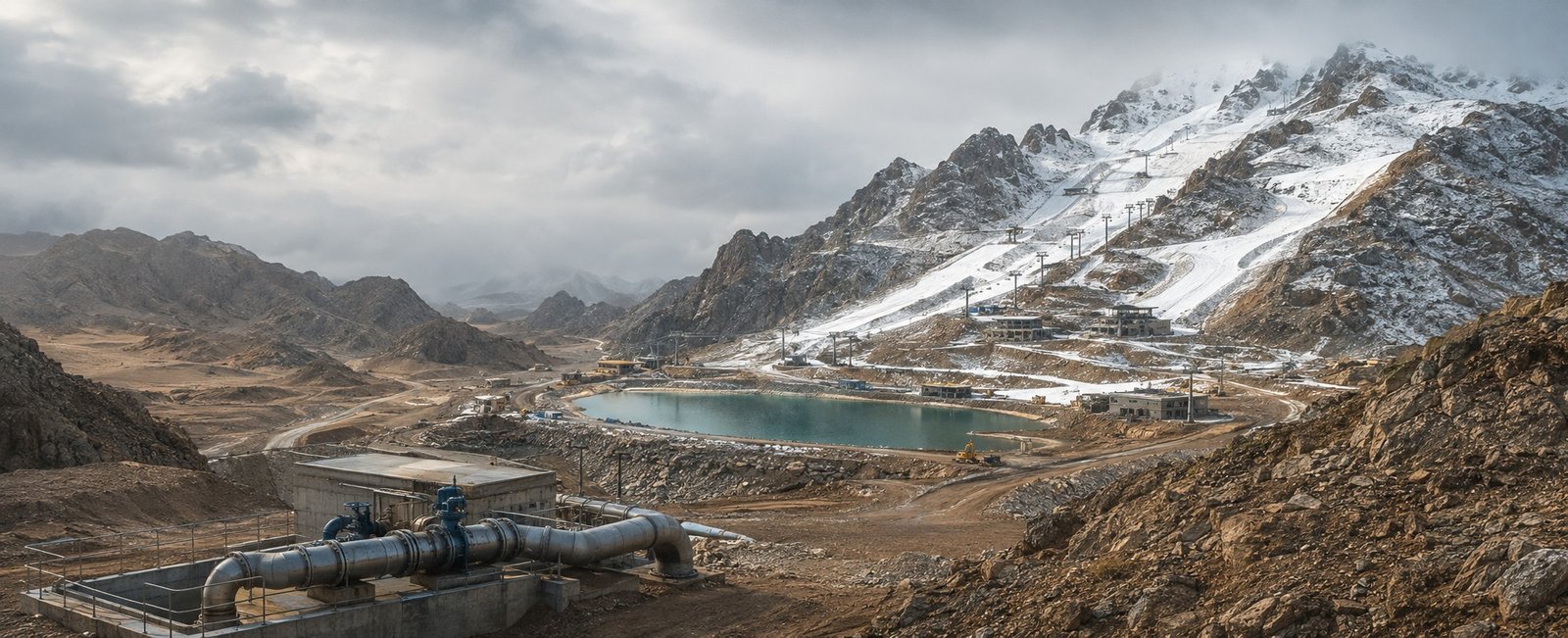
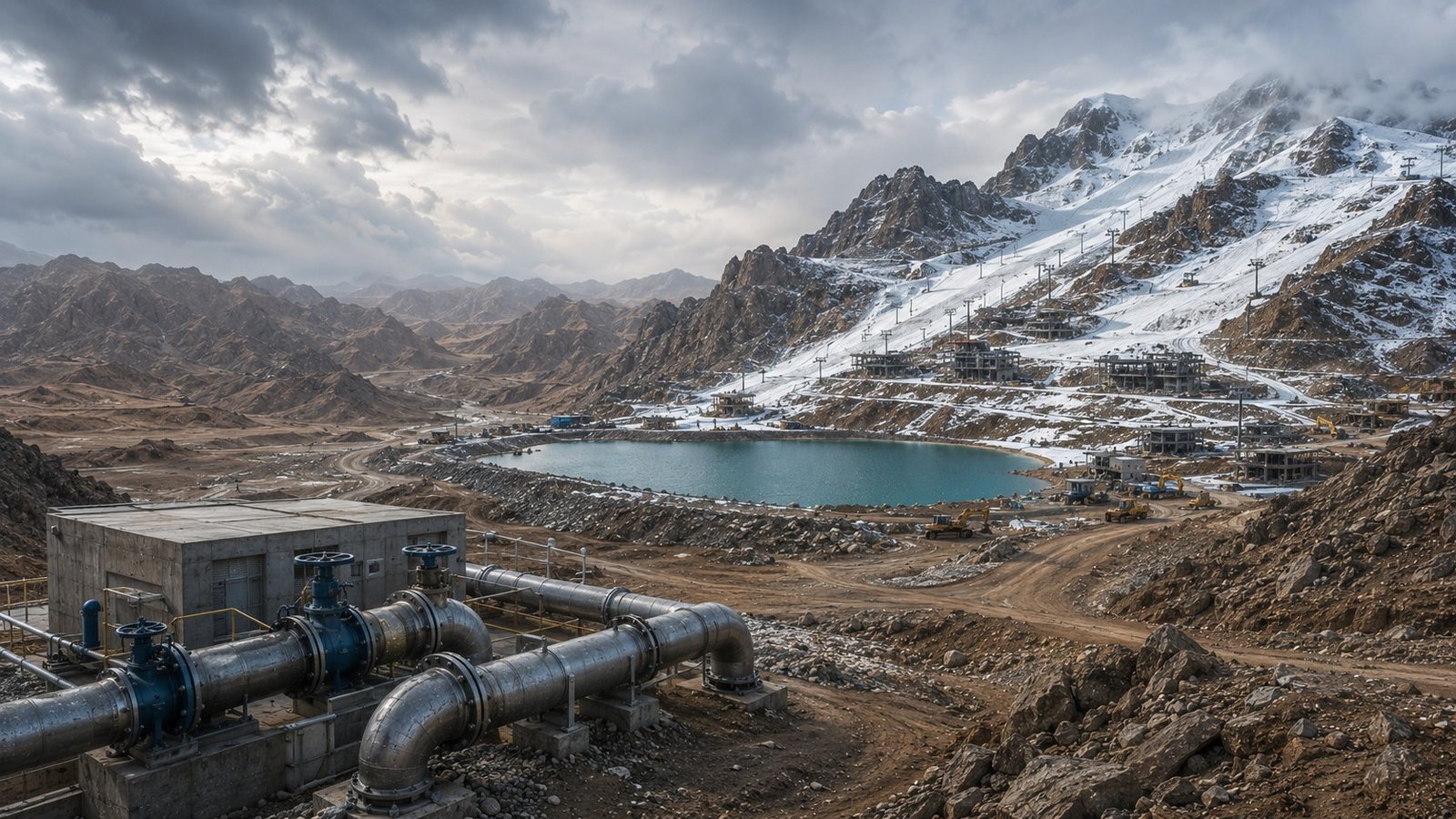
Trojena is a year-round mountain tourism destination under construction in the Sarawat Mountains within NEOM, at an elevation of roughly 2,600 metres. Masterplanned by architecture studio LAVA, with buildings designed by firms including Zaha Hadid Architects, UNStudio, and Aedas, the project centers on an artificial lake roughly 2.8 kilometres long, alongside ski terrain, luxury hotels, and a wellness village. Cost estimates for Trojena specifically have varied across reporting, ranging from roughly $19 billion to $38 billion, reflecting the scale and complexity of building a genuine ski destination in a location that receives little natural snowfall.
The “Desalination-to-Snow” Pipeline: The Core Technical Bottleneck
Why it matters: This is the detail that explains far more about Trojena’s timeline problems than any single financial or political factor.
Trojena sits inland and at elevation, in a region with essentially no reliable freshwater source of its own. To fill its artificial lake and supply its snowmaking systems, water has to be desalinated at the coast, near Sharma on the Gulf of Aqaba, then transported roughly 200 kilometres inland and pumped up approximately 2.6 kilometres in elevation gain before it ever reaches the resort. That entire chain, desalination, long-distance transport, and high-elevation pumping, is the infrastructure system underpinning everything from the lake’s 140-metre depth to the resort’s artificial snow production.
According to reporting from mid-2025, construction on the Sharma desalination plant meant to power this system had not yet begun, despite an original schedule calling for lake filling to start that same year. In the meantime, water was being trucked in solely to support construction activity and basic on-site consumption, nowhere near the volume needed to fill a lake of that scale or sustain snowmaking operations.
Why this bottleneck matters more than it might seem: Nearly every visible, marketable element of Trojena, the lake, the snow, the aquatic activities planned around the dam system, depends entirely on this single infrastructure chain being complete and operational. A luxury hotel can open before every amenity is finished. A ski resort’s core lake and snow system cannot meaningfully open at all until its water supply chain is actually functioning.
Independent research has also raised longer-term questions about the approach. A 2025 academic study modeling snow supply at Trojena estimated the annual energy cost of desalinating, transporting, and lifting water to elevation for snowmaking at several gigawatt-hours per year, and projected that even with full artificial snow production capacity, the number of reliably skiable days at lower elevations within the resort could fall toward zero by the 2050s under current climate change trajectories.
Official vs Reported Reasons for the Reassignment
Why it matters: It’s worth being clear about what’s confirmed versus what’s inferred from reporting, since coverage of this story has varied in how directly it names the cause.
The OCA’s own statement cited consultations and a shared commitment to sustainable winter sports development, without naming construction delays or infrastructure issues directly. Multiple independent outlets, however, have reported that the postponement and reassignment followed months of questions specifically around financial feasibility, sustainability claims, safety considerations, and construction pace, with the incomplete desalination and water transport system representing the most concrete, verifiable element behind those broader concerns.
One industry analysis following the announcement framed the decision around operational readiness rather than ambition alone, noting that Almaty offered organizers certainty, including prior experience hosting the Asian Winter Games in 2011, in a way that a still-under-construction resort with an unfinished core water system could not.
What Happens to Trojena Now?
Why it matters: Losing the 2029 Games is a setback for Trojena’s timeline and visibility, but it isn’t confirmation the project itself has been cancelled.
Reporting following the postponement indicated Saudi officials intended to negotiate a future date to host the Asian Winter Games at NEOM once the resort is ready, framing the delay partly as an opportunity to develop a domestic winter sports culture in the meantime. Construction on Trojena’s broader infrastructure, including the dam system under a contract with Italian firm WeBuild, has continued to be reported as active work. What remains genuinely unclear is a firm completion timeline for the resort as a whole, and specifically for the desalination and water transport chain that everything else depends on.
What This Means for Suppliers and Contractors Watching NEOM
Why it matters: Beyond the sports headlines, Trojena’s setback carries a practical lesson for anyone evaluating supply or contracting opportunities across Saudi Arabia’s giga-project pipeline.
- Masterplan announcements aren’t a proxy for infrastructure completion. A published timeline, an architectural render, and an awarded international event don’t confirm that the underlying utility infrastructure, water, power, and logistics, is actually on track.
- Water and elevation-driven infrastructure is consistently the hidden bottleneck. As with the water storage and pump station requirements disclosed for Soudah Peaks, and the utility packages underpinning AMAALA, Diriyah, and SPARK, the less visible infrastructure, desalination, pumping, and distribution, is often what actually determines whether a headline project stays on schedule.
- Due diligence on actual construction status matters more than marketing materials. For contractors and suppliers evaluating engagement with any giga-project, verifying real infrastructure progress, not just announced timelines, is the difference between informed positioning and exposure to a project’s execution risk.
- This doesn’t necessarily signal broader giga-project weakness. Trojena’s specific challenge, moving desalinated water 200 kilometres inland and 2.6 kilometres uphill, is an unusually demanding engineering problem even by giga-project standards, and shouldn’t be read as directly representative of every other project in the pipeline.
The Broader Takeaway: Infrastructure First
Across nearly every Saudi giga-project we’ve covered, from AMAALA to Diriyah Gate to SPARK and Soudah Peaks, water and utility infrastructure keeps surfacing as the least glamorous, most operationally critical piece of the puzzle. Trojena’s story is simply the clearest public example yet of what happens when that infrastructure lags behind the vision built on top of it. For suppliers and contractors in this space, it’s a reminder that expertise in water systems, pumps, and elevation-driven engineering isn’t a secondary consideration to giga-project delivery, it’s frequently the deciding factor.
Your next steps:
- When evaluating any giga-project opportunity, verify actual infrastructure progress directly rather than relying on masterplan timelines alone.
- Pay particular attention to water supply chains on any site involving significant elevation change or remote desalination dependency.
- Explore Kanzotech’s water pumps and industrial pump range for insight into the kind of elevation and pressure engineering these projects depend on.
Evaluating infrastructure requirements for a large-scale project in Saudi Arabia? Contact Kanzotech to discuss water system and pump engineering considerations for your site.










Comments
No comments yet. Be the first to comment!