King Salman Park: Riyadh’s Green Giga-Project and What It Needs From Suppliers

POSTED BY: Hyzam Kanzo / August 6, 2026
Views
53 Views
0 Comments

Introduction

Most giga-projects reshape a coastline or a stretch of desert. King Salman Park is reshaping the middle of Riyadh itself, turning a 16.9-square-kilometre former airbase into what’s set to become the world’s largest urban park, roughly seven times the size of London’s Hyde Park. It sits at the geographic center of the city, and unlike a resort destination on the coast, its supply chain runs straight through the capital’s own contractor and trader network.

This piece looks at where construction actually stands, what a project built around a million trees and an arid-climate irrigation system needs from its suppliers, and what it takes to be positioned for the work still ahead.

Where King Salman Park Actually Stands

Why it matters: Like most giga-projects, King Salman Park isn’t one build with one completion date. It’s a phased programme spread across roughly six major packages, and knowing which pieces are furthest along tells a supplier where near-term demand is concentrated.

  • The park spans 16.9 square kilometres on the site of Riyadh’s former military airbase, with an estimated project cost of SR72 billion.
  • Initial phases, including the Art Park section, are set to open in late 2026, with substantial completion targeted for 2027 and some elements continuing beyond that.
  • Landscaping contracts worth close to $2.5 billion have been awarded, the larger package to Nesma & Partners at roughly $2 billion, and a second to Al-Rashid Trading & Contracting Company.
  • A $480 million infrastructure package, covering roads, electrical distribution, irrigation networks, potable water networks, and sewage and stormwater systems, is under construction, following an earlier infrastructure and MEP works package.
  • The operations and maintenance building, a key part of the park’s long-term facilities management, was completed in June 2026, signalling that later-stage, operational infrastructure is now coming online alongside the earlier civil works.
  • Over 13 million cubic metres of soil have already been excavated, and roughly one million trees are planned across the site, supported by treated wastewater irrigation and soil regeneration systems built for Riyadh’s arid climate.

Why it matters: With multiple packages still in planning or early stages, and a project timeline that extends into 2027 and beyond, King Salman Park isn’t a narrow supply window. It’s a multi-year build with several more contract awards still to come.

Why a Green Giga-Project Needs a Different Kind of Supply Chain

Why it matters: A park built to support a million trees, treated wastewater irrigation, and a district cooling network has very different material demands than a typical commercial or residential build, and that shapes who’s actually positioned to supply it.

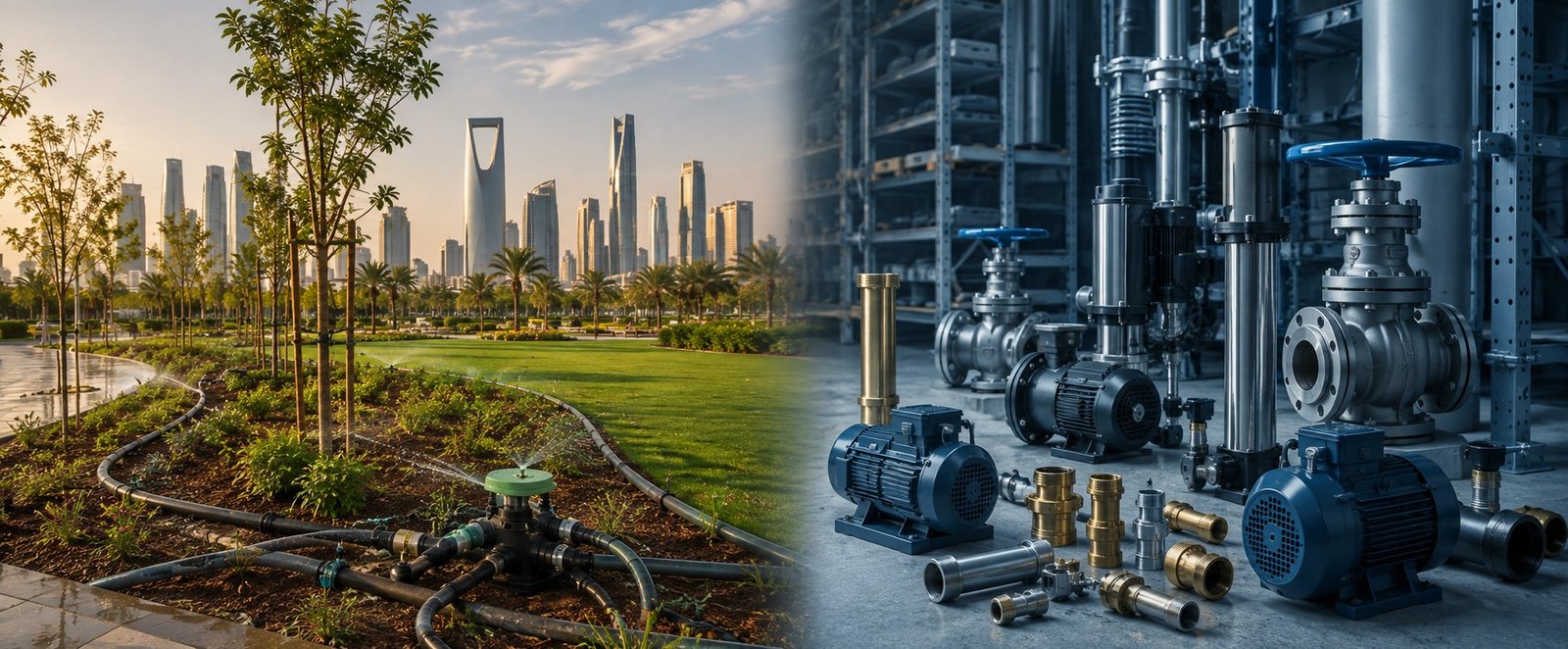
  • Large-scale irrigation infrastructure. Sustaining a million trees and expansive green space in an arid climate depends on dependable, high-capacity pump systems, not just for irrigation, but for the treated wastewater network feeding it.
  • Potable water and sanitary networks at district scale. The infrastructure package alone spans potable water, sewage, and stormwater systems across a 16.9-square-kilometre site, work that requires pumps, valves, and fittings sized for continuous public use.
  • District cooling infrastructure. A cooling plant designed for tens of thousands of refrigeration tonnes, serving the park’s built-up areas, adds another layer of mechanical and plumbing demand beyond standard landscaping and irrigation work.
  • Durable materials for high-traffic public space. With over 150 planned attractions and heavy day-to-day public use expected once phases open, fittings and hardware need to hold up to a different wear pattern than a private development.

What Makes a Supplier Ready for This Kind of Work

Why it matters: With landscaping, infrastructure, and MEP packages split across multiple large contractors, suppliers need to be positioned to work with several of them, not just one.

  • In-house manufacturing, not resale. Contractors managing tightly scheduled, high-visibility public infrastructure need suppliers who control their own production timelines and quality.
  • Certified quality standards. ISO certification and documented quality control are baseline expectations for suppliers being considered on a project of this profile.
  • A broad, consolidated product range. Covering pumps, valves, faucets, and building accessories under one supplier reduces coordination overhead for contractors managing irrigation, potable water, and public-facility fit-out simultaneously.
  • Nationwide stock and delivery, with genuine Riyadh presence. A central Riyadh location means proximity and delivery reliability carry real weight, on top of national distribution reach.
  • A track record with established contractors. Existing relationships with firms like Nesma & Partners, already active on major Saudi giga-projects, carry weight with procurement teams evaluating new suppliers for a project of this scale.

The Local Content Factor

Why it matters: The Local Content and Government Procurement Authority’s push under Vision 2030 has steadily raised how much of a project’s value needs to be generated inside the Kingdom, through local manufacturing, local labour, and local supply chains. A publicly funded, government-overseen project like King Salman Park sits directly inside this framework.

For suppliers, that shifts the competitive edge away from whoever can source the cheapest imported product and toward whoever can manufacture, stock, and deliver locally, consistently, and to documented quality standards. That shift is reinforced by the LCGPA’s recent move to name specific products, including water pumps and water valves, on its Mandatory List for government procurement, effective August 2027.

Practical tip: Suppliers evaluating whether to expand local manufacturing capacity, rather than continuing to import and resell, should weigh this seriously for work tied to publicly funded developments like King Salman Park. It’s increasingly a factor in which suppliers actually get selected, not just a compliance checkbox.

What This Means for Kanzotech’s Position

Kanzotech has spent over 25 years building the kind of manufacturing and distribution footprint that giga-project procurement now rewards: in-house production across water pumps, faucets, and building accessories, ISO-certified quality control, and a distribution network reaching branches and corporate offices across Saudi Arabia, including Riyadh, where King Salman Park sits. Our client relationships already span major names active across the Kingdom’s industrial and giga-project landscape, including Saudi Aramco, NEOM, Sadara, and Alfanar.

We’ve seen this pattern play out directly on other large-scale developments. Our ongoing work supplying water pumps for Hyde Park Tower in Riyadh through our partnership with Astra Group reflects the same dynamic now unfolding across Riyadh’s major developments, a contractor relationship in the capital translating into material supply on the ground.

Practical Takeaways for Suppliers

  • Build relationships with the contractors already active on King Salman Park, including the landscaping, infrastructure, and MEP package holders, rather than waiting for later-stage packages to open for bidding.
  • Invest in certification and documentation now, since procurement teams on public giga-projects treat this as a baseline, not a differentiator.
  • Evaluate local manufacturing capacity, given how directly local content policy, including the LCGPA’s Mandatory List, now factors into large-scale procurement decisions.
  • Focus product readiness on irrigation and water infrastructure at scale, since a million-tree, arid-climate park depends on pump and water-network capacity more than most developments.
  • Track individual contract package awards, not just the project’s headline milestones. With roughly six packages structuring the build, new supply opportunities open each time a fresh package is awarded.

Conclusion

King Salman Park is no longer a rendering of a future green Riyadh, it’s excavated, partly built, and opening its first section within the year. With around SR72 billion in estimated cost, several major packages already awarded, and more still to come through 2027 and beyond, the project represents a sustained, multi-year supply opportunity centered in the capital itself. For manufacturers and distributors across the Kingdom, the opening isn’t a direct contract with the King Salman Park Foundation, it’s positioning to be the trusted supply partner behind the contractors already building it.

Your next steps:

  1. Map which King Salman Park contractors and sub-contractors are already in your client network, or could be.
  2. Review your certification and documentation readiness against what large-scale public procurement now expects.
  3. Assess your irrigation and water-infrastructure product range against what an arid-climate, million-tree park actually requires.
  4. Explore Kanzotech’s water pumps, faucets, and building accessories ranges to see how an in-house manufactured, ISO-certified product line fits into large-scale project supply.

Looking to source materials for a large-scale development, or explore a supply partnership for a giga-project? Contact Kanzotech to discuss your project’s requirements.

Comments

No comments yet. Be the first to comment!

Your comments are valuable

Blog Detail Image

King Salman Park: Riyadh’s Green Giga-Project and What It Needs From Suppliers

POSTED BY: Hyzam Kanzo / 06 August 2026
53 Views
0 Comments

Introduction

Most giga-projects reshape a coastline or a stretch of desert. King Salman Park is reshaping the middle of Riyadh itself, turning a 16.9-square-kilometre former airbase into what’s set to become the world’s largest urban park, roughly seven times the size of London’s Hyde Park. It sits at the geographic center of the city, and unlike a resort destination on the coast, its supply chain runs straight through the capital’s own contractor and trader network.

This piece looks at where construction actually stands, what a project built around a million trees and an arid-climate irrigation system needs from its suppliers, and what it takes to be positioned for the work still ahead.

Where King Salman Park Actually Stands

Why it matters: Like most giga-projects, King Salman Park isn’t one build with one completion date. It’s a phased programme spread across roughly six major packages, and knowing which pieces are furthest along tells a supplier where near-term demand is concentrated.

  • The park spans 16.9 square kilometres on the site of Riyadh’s former military airbase, with an estimated project cost of SR72 billion.
  • Initial phases, including the Art Park section, are set to open in late 2026, with substantial completion targeted for 2027 and some elements continuing beyond that.
  • Landscaping contracts worth close to $2.5 billion have been awarded, the larger package to Nesma & Partners at roughly $2 billion, and a second to Al-Rashid Trading & Contracting Company.
  • A $480 million infrastructure package, covering roads, electrical distribution, irrigation networks, potable water networks, and sewage and stormwater systems, is under construction, following an earlier infrastructure and MEP works package.
  • The operations and maintenance building, a key part of the park’s long-term facilities management, was completed in June 2026, signalling that later-stage, operational infrastructure is now coming online alongside the earlier civil works.
  • Over 13 million cubic metres of soil have already been excavated, and roughly one million trees are planned across the site, supported by treated wastewater irrigation and soil regeneration systems built for Riyadh’s arid climate.

Why it matters: With multiple packages still in planning or early stages, and a project timeline that extends into 2027 and beyond, King Salman Park isn’t a narrow supply window. It’s a multi-year build with several more contract awards still to come.

Why a Green Giga-Project Needs a Different Kind of Supply Chain

Why it matters: A park built to support a million trees, treated wastewater irrigation, and a district cooling network has very different material demands than a typical commercial or residential build, and that shapes who’s actually positioned to supply it.

  • Large-scale irrigation infrastructure. Sustaining a million trees and expansive green space in an arid climate depends on dependable, high-capacity pump systems, not just for irrigation, but for the treated wastewater network feeding it.
  • Potable water and sanitary networks at district scale. The infrastructure package alone spans potable water, sewage, and stormwater systems across a 16.9-square-kilometre site, work that requires pumps, valves, and fittings sized for continuous public use.
  • District cooling infrastructure. A cooling plant designed for tens of thousands of refrigeration tonnes, serving the park’s built-up areas, adds another layer of mechanical and plumbing demand beyond standard landscaping and irrigation work.
  • Durable materials for high-traffic public space. With over 150 planned attractions and heavy day-to-day public use expected once phases open, fittings and hardware need to hold up to a different wear pattern than a private development.

What Makes a Supplier Ready for This Kind of Work

Why it matters: With landscaping, infrastructure, and MEP packages split across multiple large contractors, suppliers need to be positioned to work with several of them, not just one.

  • In-house manufacturing, not resale. Contractors managing tightly scheduled, high-visibility public infrastructure need suppliers who control their own production timelines and quality.
  • Certified quality standards. ISO certification and documented quality control are baseline expectations for suppliers being considered on a project of this profile.
  • A broad, consolidated product range. Covering pumps, valves, faucets, and building accessories under one supplier reduces coordination overhead for contractors managing irrigation, potable water, and public-facility fit-out simultaneously.
  • Nationwide stock and delivery, with genuine Riyadh presence. A central Riyadh location means proximity and delivery reliability carry real weight, on top of national distribution reach.
  • A track record with established contractors. Existing relationships with firms like Nesma & Partners, already active on major Saudi giga-projects, carry weight with procurement teams evaluating new suppliers for a project of this scale.

The Local Content Factor

Why it matters: The Local Content and Government Procurement Authority’s push under Vision 2030 has steadily raised how much of a project’s value needs to be generated inside the Kingdom, through local manufacturing, local labour, and local supply chains. A publicly funded, government-overseen project like King Salman Park sits directly inside this framework.

For suppliers, that shifts the competitive edge away from whoever can source the cheapest imported product and toward whoever can manufacture, stock, and deliver locally, consistently, and to documented quality standards. That shift is reinforced by the LCGPA’s recent move to name specific products, including water pumps and water valves, on its Mandatory List for government procurement, effective August 2027.

Practical tip: Suppliers evaluating whether to expand local manufacturing capacity, rather than continuing to import and resell, should weigh this seriously for work tied to publicly funded developments like King Salman Park. It’s increasingly a factor in which suppliers actually get selected, not just a compliance checkbox.

What This Means for Kanzotech’s Position

Kanzotech has spent over 25 years building the kind of manufacturing and distribution footprint that giga-project procurement now rewards: in-house production across water pumps, faucets, and building accessories, ISO-certified quality control, and a distribution network reaching branches and corporate offices across Saudi Arabia, including Riyadh, where King Salman Park sits. Our client relationships already span major names active across the Kingdom’s industrial and giga-project landscape, including Saudi Aramco, NEOM, Sadara, and Alfanar.

We’ve seen this pattern play out directly on other large-scale developments. Our ongoing work supplying water pumps for Hyde Park Tower in Riyadh through our partnership with Astra Group reflects the same dynamic now unfolding across Riyadh’s major developments, a contractor relationship in the capital translating into material supply on the ground.

Practical Takeaways for Suppliers

  • Build relationships with the contractors already active on King Salman Park, including the landscaping, infrastructure, and MEP package holders, rather than waiting for later-stage packages to open for bidding.
  • Invest in certification and documentation now, since procurement teams on public giga-projects treat this as a baseline, not a differentiator.
  • Evaluate local manufacturing capacity, given how directly local content policy, including the LCGPA’s Mandatory List, now factors into large-scale procurement decisions.
  • Focus product readiness on irrigation and water infrastructure at scale, since a million-tree, arid-climate park depends on pump and water-network capacity more than most developments.
  • Track individual contract package awards, not just the project’s headline milestones. With roughly six packages structuring the build, new supply opportunities open each time a fresh package is awarded.

Conclusion

King Salman Park is no longer a rendering of a future green Riyadh, it’s excavated, partly built, and opening its first section within the year. With around SR72 billion in estimated cost, several major packages already awarded, and more still to come through 2027 and beyond, the project represents a sustained, multi-year supply opportunity centered in the capital itself. For manufacturers and distributors across the Kingdom, the opening isn’t a direct contract with the King Salman Park Foundation, it’s positioning to be the trusted supply partner behind the contractors already building it.

Your next steps:

  1. Map which King Salman Park contractors and sub-contractors are already in your client network, or could be.
  2. Review your certification and documentation readiness against what large-scale public procurement now expects.
  3. Assess your irrigation and water-infrastructure product range against what an arid-climate, million-tree park actually requires.
  4. Explore Kanzotech’s water pumps, faucets, and building accessories ranges to see how an in-house manufactured, ISO-certified product line fits into large-scale project supply.

Looking to source materials for a large-scale development, or explore a supply partnership for a giga-project? Contact Kanzotech to discuss your project’s requirements.

Comments

No comments yet. Be the first to comment!

Footer Logo

Let Life Flow With Us!

OFFICE LOCATION

Al Kolibi Tower,
King Saud Street
P.B No: 32426, Dammam,
Saudi Arabia

CONTACT

sales@kanzotech com

info@kanzotech.com

+966 55 981 0470

+966 54 750 9351