Qiddiya 2026: Construction Status and Supplier Opportunities

POSTED BY: Hyzam Kanzo / August 4, 2026
Views
44 Views
0 Comments

Introduction

Qiddiya spent years as a rendering, a 360-square-kilometre outline on the edge of the Tuwaiq escarpment with a long list of things it would eventually contain. That’s no longer the case. Six Flags Qiddiya City opened at the end of 2025. Aquarabia followed in March 2026. The Prince Mohammed bin Salman Stadium and the Qiddiya Speed Park motorsports circuit are both under active construction, and new contracts are still being awarded across the site as 2026 continues.

For manufacturers and suppliers across the Kingdom, that shift from planning to delivery changes what the opportunity actually looks like. This piece covers where Qiddiya’s major components stand right now, what a project at this scale and pace needs from its supply chain, and what positions a supplier to be part of it.

Where Qiddiya Actually Stands in 2026

Why it matters: Qiddiya isn’t one project with one delivery date, it’s a rolling programme of individually contracted venues, each on its own construction timeline. Understanding which pieces are open, which are mid-build, and which are just starting tells a supplier where the live demand actually is right now.

  • Six Flags Qiddiya City opened on December 31, 2025, as the first Six Flags park in the Middle East, home to Falcon’s Flight, the world’s tallest and fastest roller coaster.
  • Aquarabia, the Middle East’s largest water theme park, opened in March 2026 for the Eid al-Fitr holidays.
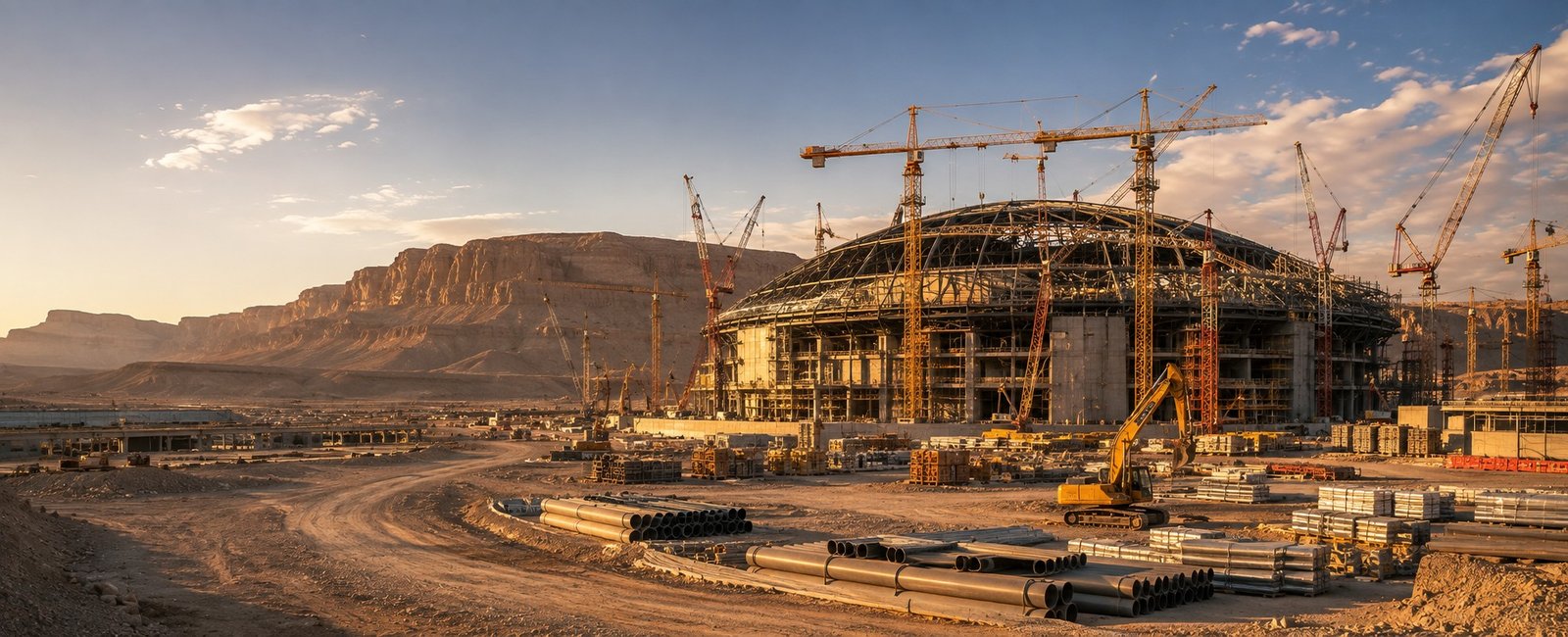
  • Prince Mohammed bin Salman Stadium, a 46,979-seat venue and a confirmed 2034 FIFA World Cup host site, broke ground in late 2024 and is under construction now, with completion targeted for 2029.
  • Qiddiya Speed Park, the Kingdom’s new Formula One-capable motorsports circuit, is well into construction, with contracts for spectator and hospitality buildings still being awarded through mid-2026.
  • The Performing Arts Centre, a cliff-edge venue with specialised MEP requirements for VR, AR, and AI stage systems, broke ground in February 2026.
  • The Qiddiya Racecourse, an international horse racing venue, moved into its construction phase in 2026 following a roughly $1.1 billion main contract award.

Why it matters: Development at Qiddiya is planned to continue through 2050, which means this isn’t a narrow supply window tied to a single opening date. New venues, new phases, and new contracts will keep entering construction for years, giving suppliers repeated entry points rather than one shot at involvement.

Why This Matters Beyond the Headline Contractors

Why it matters: The consortiums and main contractors winning Qiddiya’s headline announcements, names like Nesma & Partners, FCC Construcción, and El Seif, aren’t the ones sourcing plumbing, pumps, valves, and building hardware directly. That sits with the manufacturers and distributors behind them, and every major contract award at Qiddiya generates a matching wave of demand at that level.

A stadium with a retractable roof and an underground cooling lake, a motorsports circuit with permanent spectator buildings, a performing arts centre with specialised climate and MEP systems, none of these get built without a deep bench of suppliers providing the actual materials that go into the walls, the water systems, and the finishes. That layer of the supply chain is where most of the opportunity sits, and it’s far less visible than the contractor announcements that make the news.

What Qiddiya’s Venues Actually Need From Suppliers

Why it matters: Entertainment and sports venues at this scale have material requirements that go beyond a standard commercial build, and the specifics vary meaningfully by venue type.

  • High-spec plumbing and water systems for guest-facing venues. Theme parks, water parks, and hospitality buildings all carry higher expectations for fixture quality, reliability, and finish than standard residential or commercial work.
  • Industrial-grade pumps for large-scale water features and utilities. A water park the size of Aquarabia, a stadium’s cooling infrastructure, and site-wide irrigation across a 360-square-kilometre development all depend on dependable pump systems operating continuously under heavy use.
  • Materials built for desert climate extremes. Qiddiya’s location on the Tuwaiq escarpment means construction materials face significant heat, dust, and temperature swings, conditions that push standard-grade fittings and hardware toward premature failure.
  • Bulk supply that keeps pace with a fast-moving, multi-venue build. With several venues under construction simultaneously and more entering the pipeline through 2026, contractors need suppliers who can deliver consistently across multiple sites at once, not just fulfil a single order.

What Makes a Supplier Ready for Giga-Project Work

Why it matters: Qiddiya’s contractors are managing tightly scheduled, high-visibility builds tied to fixed dates like the 2034 World Cup. Not every supplier is set up to meet what that actually requires.

  • In-house manufacturing, not resale. Contractors need suppliers who control their own production timelines and quality, rather than depending on a third-party factory further down the chain.
  • Certified quality standards. ISO certification and documented quality control are baseline expectations before a supplier is even considered for work at this scale.
  • A broad, consolidated product range. Fewer, more capable suppliers covering plumbing, pumps, valves, and building accessories reduce coordination overhead for contractors juggling multiple disciplines on a single site.
  • Nationwide stock and delivery. A supplier with distribution reach across Saudi Arabia, not just Riyadh, reduces the risk of material gaps holding up a schedule tied to a fixed opening date.
  • A track record with established contractors. Existing relationships with firms already active on major Saudi developments carry real weight with procurement teams evaluating new suppliers.

The Local Content Factor

Why it matters: The Local Content and Government Procurement Authority’s push under Vision 2030 has steadily raised how much of a project’s value needs to be generated inside the Kingdom, through local manufacturing, local labour, and local supply chains rather than imported goods. Giga-projects tied to Vision 2030, Qiddiya included, sit directly inside this framework.

For suppliers, that shifts the competitive edge away from whoever can source the cheapest imported product and toward whoever can manufacture, stock, and deliver locally, consistently, and to documented quality standards. A Saudi-based manufacturer with in-house production and nationwide distribution is better positioned under this framework than an importer reselling from overseas.

Practical tip: Suppliers weighing whether to expand local manufacturing capacity rather than continuing to import and resell should treat this as more than a compliance checkbox. It’s increasingly a factor in which suppliers actually get selected for large-scale project work, including at Qiddiya.

What This Means for Kanzotech’s Position

Kanzotech has spent over 25 years building the kind of manufacturing and distribution footprint that giga-project procurement now rewards: in-house production across water pumps, faucets, and building accessories, ISO-certified quality control, and a distribution network reaching branches and corporate offices across Saudi Arabia, including Riyadh, where Qiddiya sits. Our client relationships already span major names active across the Kingdom’s industrial and giga-project landscape, including Saudi Aramco, NEOM, Sadara, and Alfanar.

We’ve seen this pattern play out directly on other large-scale developments. Our ongoing work supplying water pumps for Hyde Park Tower in Riyadh through our partnership with Astra Group reflects the same dynamic that’s now unfolding at Qiddiya, a relationship with a contractor active on a major development translating into material supply on the ground.

Practical Takeaways for Suppliers Watching This Space

  • Build relationships with Qiddiya’s main and sub-contractors now, rather than waiting for a direct RFQ once a venue’s construction is already underway.
  • Invest in certification and documentation, since procurement teams on giga-projects treat this as a baseline requirement, not a differentiator.
  • Evaluate local manufacturing capacity, given how directly local content policy now factors into large-scale procurement decisions.
  • Focus product development on climate-resilient, high-spec requirements, heat and dust resistance, consistent bulk reliability, and hospitality-grade finish quality, since these are where standard product lines fall short.
  • Track contractor and sub-contractor announcements, not just QIC’s own updates. The real supply opportunities tend to follow the firms actually building each venue, not just the developer’s press releases.

Conclusion

Qiddiya has moved past the point of being a plan on paper. Two of its venues are open and welcoming guests, several more are under active construction, and new contracts are still being signed as 2026 continues, with development set to run through 2050. For manufacturers and distributors across the Kingdom, the opportunity isn’t a direct contract with Qiddiya Investment Company itself, it’s positioning to be the trusted supply partner behind the contractors already building it.

Your next steps:

  1. Map which contractors and sub-contractors active at Qiddiya are already in your client network, or could be.
  2. Review your certification and documentation readiness against what large-scale procurement now expects.
  3. Assess whether local manufacturing capacity, versus importing and reselling, better positions your business for this shift.
  4. Explore Kanzotech’s water pumps, faucets, and building accessories ranges to see how an in-house manufactured, ISO-certified product line fits into large-scale project supply.

Looking to source materials for a large-scale development, or explore a supply partnership for a giga-project? Contact Kanzotech to discuss your project’s requirements.

Comments

No comments yet. Be the first to comment!

Your comments are valuable

Blog Detail Image

Qiddiya 2026: Construction Status and Supplier Opportunities

POSTED BY: Hyzam Kanzo / 04 August 2026
44 Views
0 Comments

Introduction

Qiddiya spent years as a rendering, a 360-square-kilometre outline on the edge of the Tuwaiq escarpment with a long list of things it would eventually contain. That’s no longer the case. Six Flags Qiddiya City opened at the end of 2025. Aquarabia followed in March 2026. The Prince Mohammed bin Salman Stadium and the Qiddiya Speed Park motorsports circuit are both under active construction, and new contracts are still being awarded across the site as 2026 continues.

For manufacturers and suppliers across the Kingdom, that shift from planning to delivery changes what the opportunity actually looks like. This piece covers where Qiddiya’s major components stand right now, what a project at this scale and pace needs from its supply chain, and what positions a supplier to be part of it.

Where Qiddiya Actually Stands in 2026

Why it matters: Qiddiya isn’t one project with one delivery date, it’s a rolling programme of individually contracted venues, each on its own construction timeline. Understanding which pieces are open, which are mid-build, and which are just starting tells a supplier where the live demand actually is right now.

  • Six Flags Qiddiya City opened on December 31, 2025, as the first Six Flags park in the Middle East, home to Falcon’s Flight, the world’s tallest and fastest roller coaster.
  • Aquarabia, the Middle East’s largest water theme park, opened in March 2026 for the Eid al-Fitr holidays.
  • Prince Mohammed bin Salman Stadium, a 46,979-seat venue and a confirmed 2034 FIFA World Cup host site, broke ground in late 2024 and is under construction now, with completion targeted for 2029.
  • Qiddiya Speed Park, the Kingdom’s new Formula One-capable motorsports circuit, is well into construction, with contracts for spectator and hospitality buildings still being awarded through mid-2026.
  • The Performing Arts Centre, a cliff-edge venue with specialised MEP requirements for VR, AR, and AI stage systems, broke ground in February 2026.
  • The Qiddiya Racecourse, an international horse racing venue, moved into its construction phase in 2026 following a roughly $1.1 billion main contract award.

Why it matters: Development at Qiddiya is planned to continue through 2050, which means this isn’t a narrow supply window tied to a single opening date. New venues, new phases, and new contracts will keep entering construction for years, giving suppliers repeated entry points rather than one shot at involvement.

Why This Matters Beyond the Headline Contractors

Why it matters: The consortiums and main contractors winning Qiddiya’s headline announcements, names like Nesma & Partners, FCC Construcción, and El Seif, aren’t the ones sourcing plumbing, pumps, valves, and building hardware directly. That sits with the manufacturers and distributors behind them, and every major contract award at Qiddiya generates a matching wave of demand at that level.

A stadium with a retractable roof and an underground cooling lake, a motorsports circuit with permanent spectator buildings, a performing arts centre with specialised climate and MEP systems, none of these get built without a deep bench of suppliers providing the actual materials that go into the walls, the water systems, and the finishes. That layer of the supply chain is where most of the opportunity sits, and it’s far less visible than the contractor announcements that make the news.

What Qiddiya’s Venues Actually Need From Suppliers

Why it matters: Entertainment and sports venues at this scale have material requirements that go beyond a standard commercial build, and the specifics vary meaningfully by venue type.

  • High-spec plumbing and water systems for guest-facing venues. Theme parks, water parks, and hospitality buildings all carry higher expectations for fixture quality, reliability, and finish than standard residential or commercial work.
  • Industrial-grade pumps for large-scale water features and utilities. A water park the size of Aquarabia, a stadium’s cooling infrastructure, and site-wide irrigation across a 360-square-kilometre development all depend on dependable pump systems operating continuously under heavy use.
  • Materials built for desert climate extremes. Qiddiya’s location on the Tuwaiq escarpment means construction materials face significant heat, dust, and temperature swings, conditions that push standard-grade fittings and hardware toward premature failure.
  • Bulk supply that keeps pace with a fast-moving, multi-venue build. With several venues under construction simultaneously and more entering the pipeline through 2026, contractors need suppliers who can deliver consistently across multiple sites at once, not just fulfil a single order.

What Makes a Supplier Ready for Giga-Project Work

Why it matters: Qiddiya’s contractors are managing tightly scheduled, high-visibility builds tied to fixed dates like the 2034 World Cup. Not every supplier is set up to meet what that actually requires.

  • In-house manufacturing, not resale. Contractors need suppliers who control their own production timelines and quality, rather than depending on a third-party factory further down the chain.
  • Certified quality standards. ISO certification and documented quality control are baseline expectations before a supplier is even considered for work at this scale.
  • A broad, consolidated product range. Fewer, more capable suppliers covering plumbing, pumps, valves, and building accessories reduce coordination overhead for contractors juggling multiple disciplines on a single site.
  • Nationwide stock and delivery. A supplier with distribution reach across Saudi Arabia, not just Riyadh, reduces the risk of material gaps holding up a schedule tied to a fixed opening date.
  • A track record with established contractors. Existing relationships with firms already active on major Saudi developments carry real weight with procurement teams evaluating new suppliers.

The Local Content Factor

Why it matters: The Local Content and Government Procurement Authority’s push under Vision 2030 has steadily raised how much of a project’s value needs to be generated inside the Kingdom, through local manufacturing, local labour, and local supply chains rather than imported goods. Giga-projects tied to Vision 2030, Qiddiya included, sit directly inside this framework.

For suppliers, that shifts the competitive edge away from whoever can source the cheapest imported product and toward whoever can manufacture, stock, and deliver locally, consistently, and to documented quality standards. A Saudi-based manufacturer with in-house production and nationwide distribution is better positioned under this framework than an importer reselling from overseas.

Practical tip: Suppliers weighing whether to expand local manufacturing capacity rather than continuing to import and resell should treat this as more than a compliance checkbox. It’s increasingly a factor in which suppliers actually get selected for large-scale project work, including at Qiddiya.

What This Means for Kanzotech’s Position

Kanzotech has spent over 25 years building the kind of manufacturing and distribution footprint that giga-project procurement now rewards: in-house production across water pumps, faucets, and building accessories, ISO-certified quality control, and a distribution network reaching branches and corporate offices across Saudi Arabia, including Riyadh, where Qiddiya sits. Our client relationships already span major names active across the Kingdom’s industrial and giga-project landscape, including Saudi Aramco, NEOM, Sadara, and Alfanar.

We’ve seen this pattern play out directly on other large-scale developments. Our ongoing work supplying water pumps for Hyde Park Tower in Riyadh through our partnership with Astra Group reflects the same dynamic that’s now unfolding at Qiddiya, a relationship with a contractor active on a major development translating into material supply on the ground.

Practical Takeaways for Suppliers Watching This Space

  • Build relationships with Qiddiya’s main and sub-contractors now, rather than waiting for a direct RFQ once a venue’s construction is already underway.
  • Invest in certification and documentation, since procurement teams on giga-projects treat this as a baseline requirement, not a differentiator.
  • Evaluate local manufacturing capacity, given how directly local content policy now factors into large-scale procurement decisions.
  • Focus product development on climate-resilient, high-spec requirements, heat and dust resistance, consistent bulk reliability, and hospitality-grade finish quality, since these are where standard product lines fall short.
  • Track contractor and sub-contractor announcements, not just QIC’s own updates. The real supply opportunities tend to follow the firms actually building each venue, not just the developer’s press releases.

Conclusion

Qiddiya has moved past the point of being a plan on paper. Two of its venues are open and welcoming guests, several more are under active construction, and new contracts are still being signed as 2026 continues, with development set to run through 2050. For manufacturers and distributors across the Kingdom, the opportunity isn’t a direct contract with Qiddiya Investment Company itself, it’s positioning to be the trusted supply partner behind the contractors already building it.

Your next steps:

  1. Map which contractors and sub-contractors active at Qiddiya are already in your client network, or could be.
  2. Review your certification and documentation readiness against what large-scale procurement now expects.
  3. Assess whether local manufacturing capacity, versus importing and reselling, better positions your business for this shift.
  4. Explore Kanzotech’s water pumps, faucets, and building accessories ranges to see how an in-house manufactured, ISO-certified product line fits into large-scale project supply.

Looking to source materials for a large-scale development, or explore a supply partnership for a giga-project? Contact Kanzotech to discuss your project’s requirements.

Comments

No comments yet. Be the first to comment!

Footer Logo

Let Life Flow With Us!

OFFICE LOCATION

Al Kolibi Tower,
King Saud Street
P.B No: 32426, Dammam,
Saudi Arabia

CONTACT

sales@kanzotech com

info@kanzotech.com

+966 55 981 0470

+966 54 750 9351